

Slat chain conveyors appear on a wide range of production lines, yet their advantages are rarely described with precision. Engineers evaluating conveyor options often encounter the same vague phrases — durable, flexible, easy to clean — without a clear explanation of the conditions that make those qualities relevant. That ambiguity makes selection harder, not easier.
A slat chain conveyor's core advantage is stable, continuous product support across a matched mechanical system. That advantage is most relevant when products have a reasonably firm base — bottles, cans, boxes, trays — and when the line requires guiding, curves, accumulation, or integration with upstream and downstream machines. The actual performance depends on how well the chain plates, sprockets, guide rails, wear strips, frame, and material selection work together as a system.
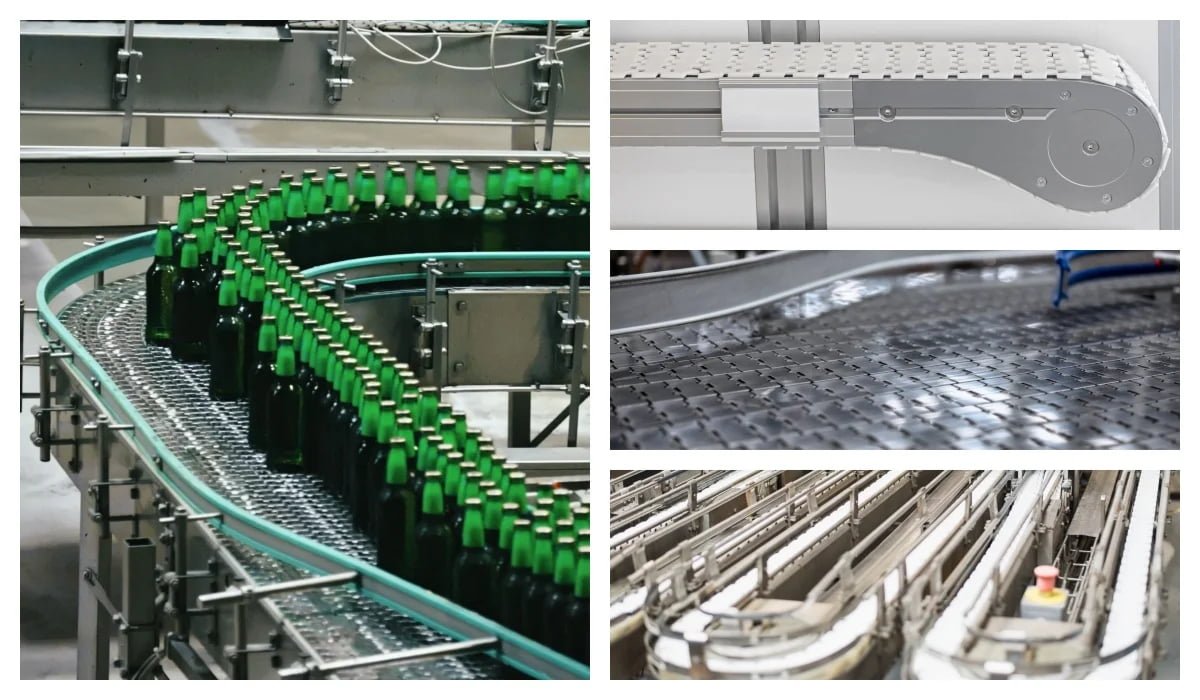
Understanding the advantages of a slat chain conveyor requires looking past the component list and asking what the conveyor is actually being asked to do. The sections below break down the working conditions where those advantages hold, and the system factors that determine whether they are realized.
Why Does Stable Product Support Matter on a Production Line?
Most conveyor selection problems start with the product, not the conveyor. When a product shifts, tips, or moves inconsistently during transport, the entire line suffers — rejected product, jammed machines, unplanned stops, and upstream/downstream timing errors accumulate quickly.
A slat chain conveyor provides a rigid, flat conveying surface formed by interlocking chain plates. For products with a stable base — bottles, cans, filled cartons, trays, or rigid containers — this surface distributes the load evenly and keeps products upright and positionally consistent as they move through the line.
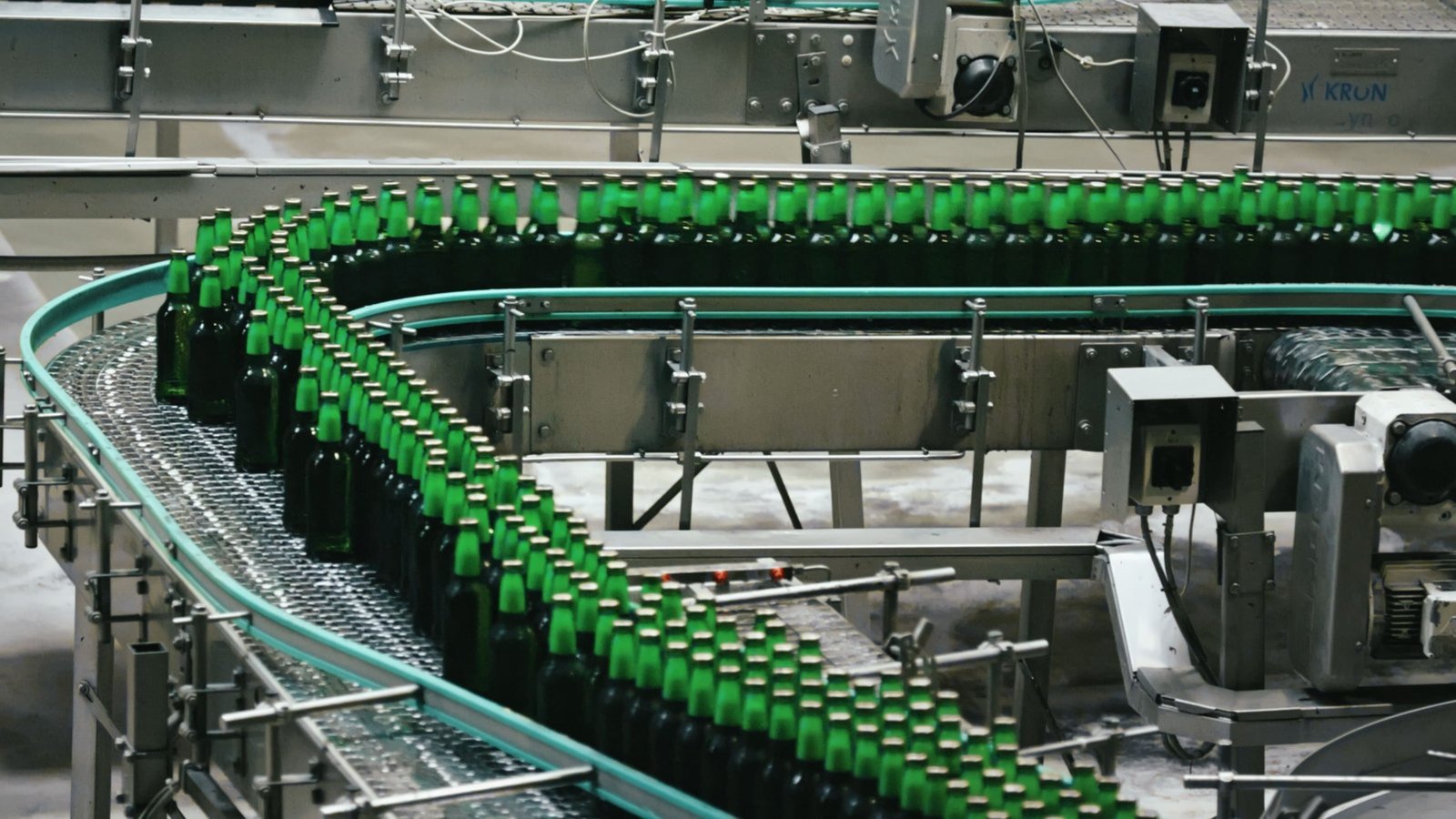
This stability is not automatic. It comes from how the system is built and matched. In our experience, the questions that matter most before selecting a conveyor are straightforward: What is the product's base shape and size? What does it weigh? What is the target line speed? How long is the conveyor run, and does it include curves or elevation changes?
What Products Are Typically Suited for Slat Chain Conveyors?
Products commonly considered for slat chain conveying share a few characteristics:
- A reasonably flat or stable base that sits without rocking or toppling on a rigid surface
- A weight distribution that allows smooth sliding or rolling contact with the chain plate surface
- Consistent geometry across a production batch, so the conveying surface and guiding system can be configured reliably
Products that are flexible, soft-bottomed, or highly irregular in shape may not perform well on a slat chain conveyor. In those cases, other conveyor types — such as modular belts or fabric belt conveyors — are often better suited. The point is not that one conveyor type is superior; it is that each type has conditions where it performs well.
How Does Line Speed Interact With Chain Plate Design?
Line speed affects chain plate selection in practical ways. Higher speeds increase the dynamic forces on the chain joints, the wear rate on guide rails and wear strips, and the likelihood of product instability at curves or transitions.
In our component supply work, we typically review:
| Factor | Why It Matters for Chain Plate Selection |
|---|---|
| Line speed (m/min) | Affects chain pitch, hinge wear, and guide rail material |
| Product base size | Determines minimum plate width and pitch |
| Curve radius | Influences plate geometry — side-flexing vs. straight-running plates |
| Load per meter | Guides material selection for plates and sprockets |
| Environment (wet/dry/chemical) | Determines material grade — standard plastic, FDA-grade, stainless steel hinge pins |
These are not abstract specifications. They are the working conditions that determine whether the chain plates run smoothly or wear prematurely.
How Does System Matching Affect Slat Chain Conveyor Performance?
A slat chain conveyor is not a single component. It is a coordinated system. Engineers who focus only on the chain plates and overlook the sprockets, guide rails, wear strips, and frame geometry often find that performance falls short of expectations — not because the chain plates were wrong, but because the system was not matched.
Every component in the conveyor system interacts with every other. When these interactions are matched correctly, the conveyor runs quietly, wears predictably, and is straightforward to maintain. When they are mismatched, wear accelerates, noise increases, and replacement intervals become unpredictable.
Sprockets
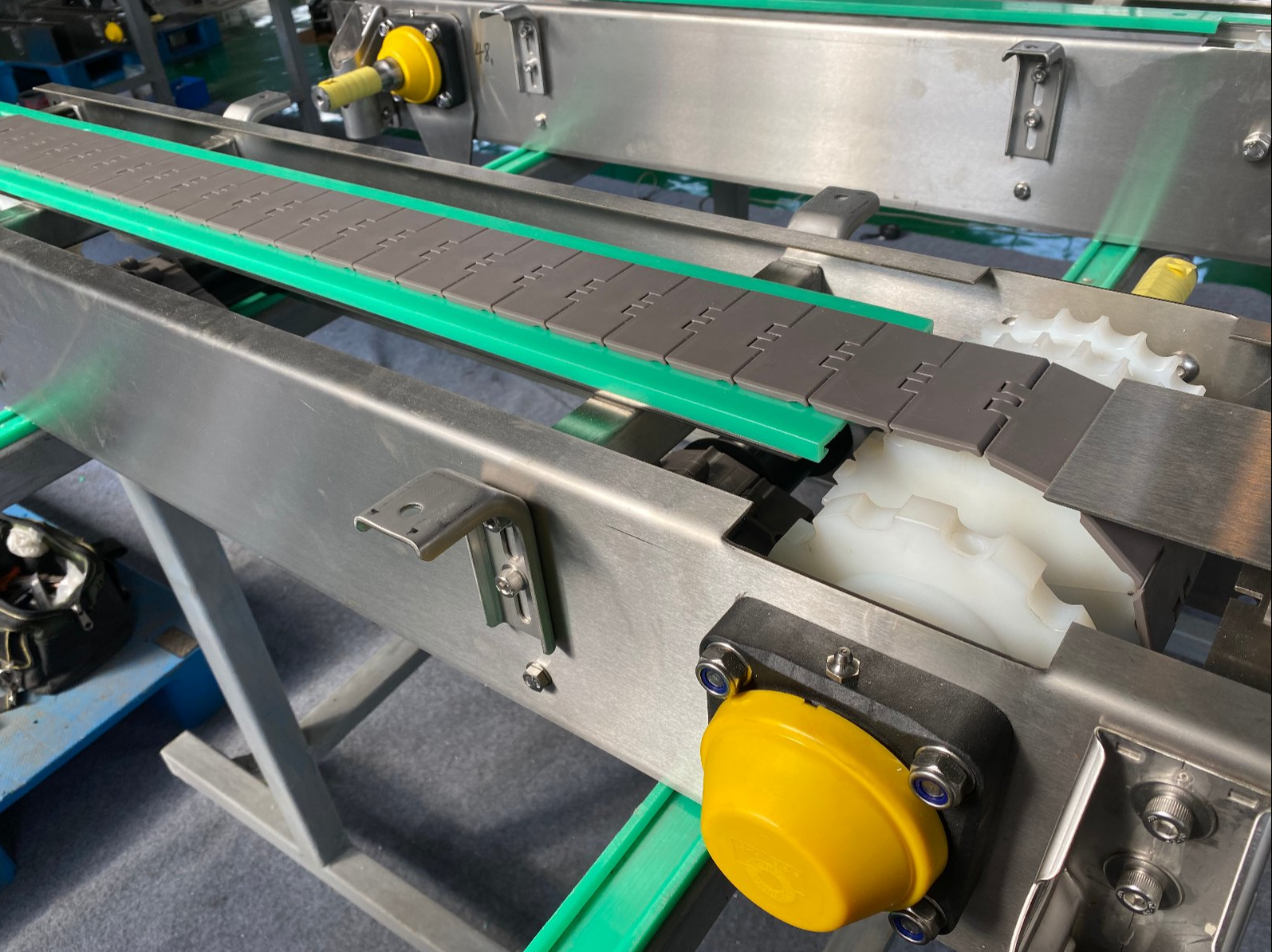
Sprockets drive the chain plates. Tooth profile, pitch, and material must match the chain plate specifications precisely. A mismatched sprocket creates uneven engagement, which introduces vibration and accelerates both sprocket and chain plate wear. In our manufacturing experience, sprocket-to-chain compatibility is one of the most common sources of premature wear when customers source components separately from different suppliers.
Guide Rails and Wear Strips
Guide rails define the product path. Wear strips sit between the chain plate underside and the frame, providing the running surface. Both components affect:
- Running noise — harder wear strip materials reduce noise at appropriate speeds; softer materials may compress unevenly
- Wear rate — the tribological pairing between the chain plate material and wear strip material determines how quickly both surfaces degrade1
- Cleaning access — wear strip profile and attachment method affect whether cleaning tools can reach the contact surfaces
Material selection for guide rails and wear strips depends on the operating environment. Dry, clean environments allow a wider range of material choices. Wet environments, washdown zones, or areas with chemical exposure narrow the selection toward materials with suitable resistance properties. We do not recommend specific material pairings without understanding the actual environment.
Frame Design
The conveyor frame sets the geometry that all other components depend on. Drive shaft alignment, tensioning system design, and support leg positioning all affect how the chain plates run over the length of the conveyor. A frame that is not level or that flexes under load will cause uneven wear across the chain width — a problem that shows up gradually and is sometimes misattributed to chain plate quality.
Where Is a Slat Chain Conveyor Often Considered on Production Lines?
Slat chain conveyors appear in a range of production environments. Understanding where they are commonly considered — and why — provides a more honest picture of their advantages than a generic feature list.
Production engineers and system integrators often evaluate slat chain conveyors when the line includes one or more of the following conditions. These are not the only valid applications, but they are conditions where the conveyor's characteristics tend to be relevant.
Curved Layouts
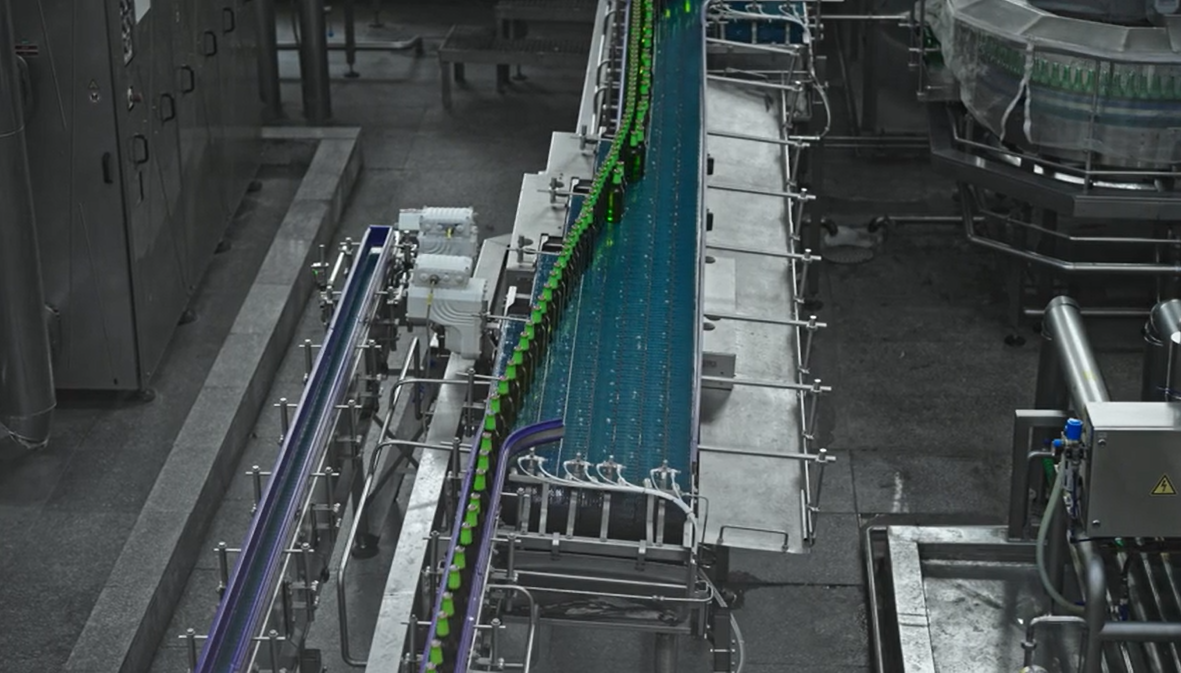
Many production facilities cannot accommodate a straight conveyor run for every section of the line. Slat chain conveyors designed with side-flexing chain plates can navigate horizontal curves without requiring a separate transfer unit at each direction change. This reduces the number of transfer points, which in turn reduces the number of locations where products can tip, jam, or lose positional alignment.
The curve radius and product size must still be matched to the chain plate geometry. Not every side-flexing plate handles every curve radius. This is a detail worth verifying with the component manufacturer before committing to a layout.
Accumulation Sections
Some production lines use accumulation zones to buffer product between machines running at different speeds or cycle times.2 Slat chain conveyors can be configured to allow products to accumulate — sliding on the moving chain surface — when downstream flow is interrupted. This reduces pressure on upstream machines and helps maintain consistent line efficiency.
The suitability of a slat chain conveyor for accumulation depends on:
- Product base material and finish — products must be able to slide on the chain plate surface without tipping or surface damage
- Chain plate surface texture — smoother surfaces facilitate sliding; textured surfaces increase traction and may not be suitable for accumulation
- Product weight — heavier products generate more friction force during accumulation, which affects chain drive sizing
Connection Between Machines
In filling, capping, labeling, and inspection lines, the conveyor connects individual machines that each have their own timing and throughput. A slat chain conveyor in these positions benefits from its predictable product positioning — products arrive at the next machine at a consistent spacing and orientation, reducing feed errors.
Hygiene-Sensitive Environments
In food, beverage, bakery, and pharmaceutical applications, cleaning and contamination control are operational requirements.3 Slat chain conveyors can be configured with materials and structures that support cleaning — but this is not automatic.
Material selection is critical. Food-grade plastics, stainless steel hinge pins, and frame designs that minimize dead zones where water and debris accumulate are all documented choices, not default specifications. Whether a given chain plate configuration supports the cleaning method used in a specific facility — wet washdown, foam cleaning, dry brushing — depends on the structure and material, and should be verified against the actual cleaning protocol.
We are careful not to claim that a slat chain conveyor is inherently hygienic. The conveyor can be designed to be compatible with hygienic operation. Whether it performs that way depends on material selection, structural design, and maintenance practice.
What Questions Help Evaluate Whether a Slat Chain Conveyor Fits a Given Application?
In our experience working with engineering and maintenance teams, the quality of the evaluation depends on the specificity of the input information. Vague specifications produce vague recommendations.
The questions below represent the working information we typically review when a customer is evaluating a slat chain conveyor for a specific application. They are not a sales checklist — they are an experience-based signal of what matters for accurate selection.
Product Characteristics
- What is the base shape, base size, and weight of the product?
- Is the product rigid or does it have a flexible or deformable base?
- Does the product need to accumulate, or must it always maintain spacing?
Line Layout and Speed
- What is the target conveying speed?
- What is the total conveyor length?
- Are there curves, elevation changes, or transitions to other conveyor types?
- What is the connection point geometry with upstream and downstream machines?
Operating Environment
- Is the environment wet, dry, or subject to washdown?
- Are there oils, cleaning chemicals, or other substances that contact the conveyor?
- What is the ambient temperature range?
Maintenance and Component Compatibility
- Are existing conveyor sections already in service? If so, what chain plate pitch and width are currently in use?
- What is the maintenance interval expectation?
- Is there a preference or requirement for specific materials — food-grade plastic, stainless steel hardware, specific color coding?
These questions do not guarantee a perfect selection, but they reduce the risk of selecting components that perform inconsistently in service. A manufacturer or supplier who does not ask questions like these before recommending a configuration is worth approaching with caution.
Frequently Asked Questions
Is a slat chain conveyor suitable for all product types?
No. A slat chain conveyor performs best with products that have a stable, reasonably flat base — bottles, cans, boxes, trays, and similar containers. Products with flexible, rounded, or highly irregular bases may not convey consistently on a rigid chain plate surface. Evaluating product geometry before selection is an important step.
How does material selection affect slat chain conveyor performance in wet environments?
Material selection directly determines performance in wet or chemically active environments. Standard plastic chain plates may degrade under certain chemical exposures or repeated washdown. Food-grade or chemically resistant materials, stainless steel hinge pins, and appropriate wear strip materials are often specified for wet environments. The actual suitability depends on the specific chemicals, temperatures, and cleaning frequencies involved.
Can slat chain conveyors handle curves?
Yes, when configured with side-flexing chain plates designed for horizontal curves. The curve radius must be compatible with the chain plate geometry and the product size. Straight-running chain plates are not suitable for curves. This is a configuration detail that should be confirmed with the component manufacturer before finalizing the conveyor layout.
What causes premature wear in a slat chain conveyor?
Common causes include mismatched sprocket-to-chain specifications, incorrect wear strip material for the operating environment, insufficient chain tensioning, and inadequate lubrication where required. Frame alignment issues and operating conditions outside the specified range — such as speeds or loads beyond design parameters — also accelerate wear. Consistent maintenance and correct initial component matching reduce wear-related issues.
How is a slat chain conveyor different from a modular belt conveyor?
Both use interlocking plastic components and share some application overlap, but they differ in structure and typical use. Slat chain conveyors use hinged chain plates running on a defined track, offering rigid surface support and predictable product positioning. Modular belt conveyors use a broader, more flexible belt surface that is often preferred for lighter products, wider load distribution, or different cleaning configurations. Neither type is universally superior; the choice depends on product, layout, speed, and environment.
Conclusion
The advantage of a slat chain conveyor is specific, not universal. It performs well when products have a stable base, when the line requires curves, guiding, accumulation, or reliable machine-to-machine connection, and when the full system — chain plates, sprockets, guide rails, wear strips, and frame — is properly matched. Hygiene and wear resistance apply only when material selection and structure are suited to the actual operating environment and maintenance practice.
At Molytech, our experience manufacturing slat chain conveyor components and equipment means we approach selection through working conditions, not feature lists. If you are evaluating whether a slat chain conveyor fits your production line, the starting point is the product, the layout, and the environment — not the brochure. Our engineering team is available to review your specifications and help identify whether the conveyor type and component configuration are a practical match for your application.
"(PDF) Friction and Wear of Polymer and Composites", https://www.academia.edu/13111110/Friction_and_Wear_of_Polymer_and_Composites. Tribology research shows that sliding wear is governed by the interacting material pair, surface condition, load, speed, and environment, supporting the article's statement that chain-plate and wear-strip material pairing affects degradation rates. Evidence role: mechanism; source type: paper. Supports: A tribology paper should support that friction and wear depend on the specific material pair, surface conditions, and operating environment.. Scope note: The cited research may test representative polymers or sliding pairs rather than the exact commercial conveyor components in the article. ↩
"Optimal Dynamic Assignment of a Flexible Worker on an ...", https://vanoyen.engin.umich.edu/wp-content/uploads/sites/150/2014/07/Floater-Sennott-VanOyen-Iravani.pdf. Manufacturing-systems research describes intermediate buffers as a means of decoupling adjacent machines and reducing the effect of speed differences or stoppages, supporting the article's description of accumulation zones. Evidence role: mechanism; source type: paper. Supports: A manufacturing systems paper should support the role of buffers or accumulation zones in decoupling machines with different cycle times or interruptions.. Scope note: The source may discuss buffers abstractly and not specifically slat-chain conveyor accumulation. ↩
"Good Manufacturing Practices for the 21st Century for Food ...", https://www.fda.gov/food/current-good-manufacturing-practices-cgmps-food-and-dietary-supplements/good-manufacturing-practices-21st-century-food-processing-2004-study-section-2-literature-review. Food-safety and pharmaceutical good-manufacturing-practice guidance requires facilities and equipment to be maintained, cleaned, and controlled to prevent contamination, supporting the article's statement that cleaning and contamination control are operational requirements in these sectors. Evidence role: expert_consensus; source type: government. Supports: A regulatory or international food/pharmaceutical guidance source should support that cleaning and contamination control are required elements of food and pharmaceutical production.. Scope note: The source establishes general regulatory expectations rather than specifying a particular slat-chain conveyor design. ↩