

Packaging, warehouse sorting, and logistics operations all rely on conveyor systems, but the equipment that works well at a filling station looks very different from what handles parcel routing in a distribution hub. Matching the wrong conveyor form to a position in the line creates friction — and not the good kind.
Conveyor systems are used across packaging, warehouse sorting, and logistics lines to move, accumulate, orient, and transfer products between process stages. The specific conveyor form — belt, modular belt, chain plate, roller, or a combination — is typically determined by the material flow position, the product type, and the operational demands of that segment of the line, not by a single universal selection rule.
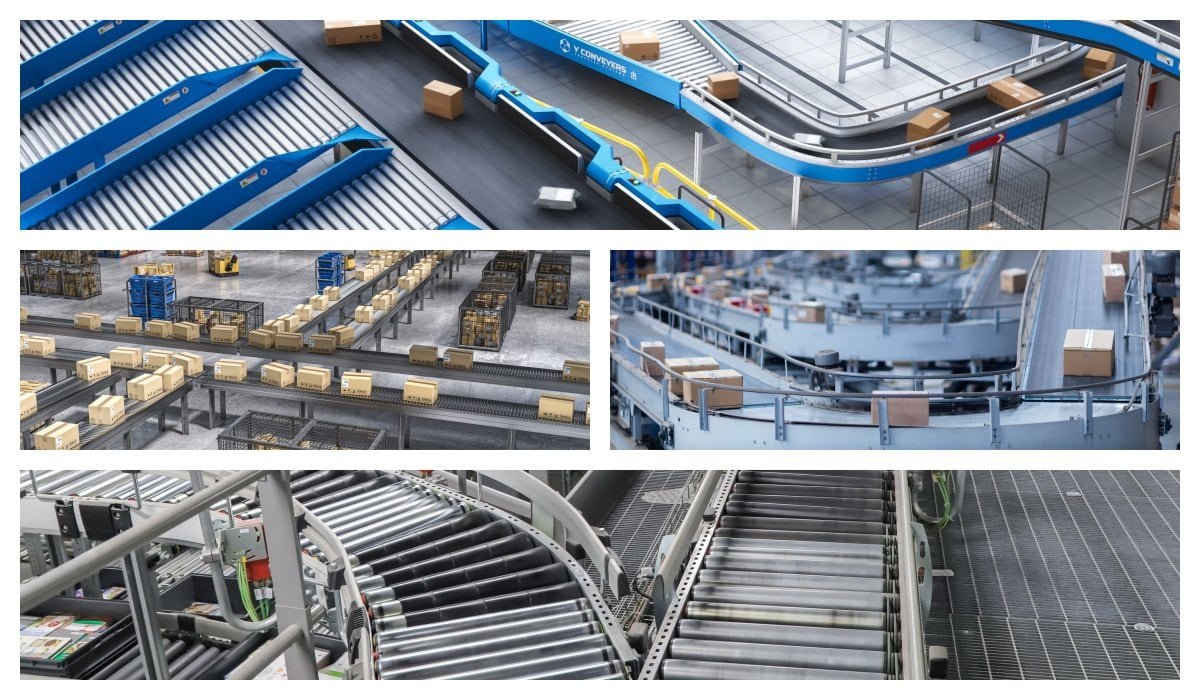
What connects these three environments is the need for continuous, predictable product flow. What separates them is how that flow behaves at each stage — and understanding those differences is where equipment selection becomes practical rather than theoretical.
How Are Conveyor Systems Used in Packaging Lines?
Packaging lines move products through a sequence of process positions — filling, sealing, labeling, inspection, coding, cartoning, and downstream palletizing1. At each handoff between stations, the conveyor system isn't a separate feature of the line; it's the connective tissue holding the process together.
In packaging line applications, conveyor systems primarily serve as product transfer and pacing mechanisms between sequential process stations. The conveyor must match the product's geometry, surface fragility, and the speed requirements of adjacent equipment — particularly where automated inspection, labeling, or packing machinery creates fixed timing demands.
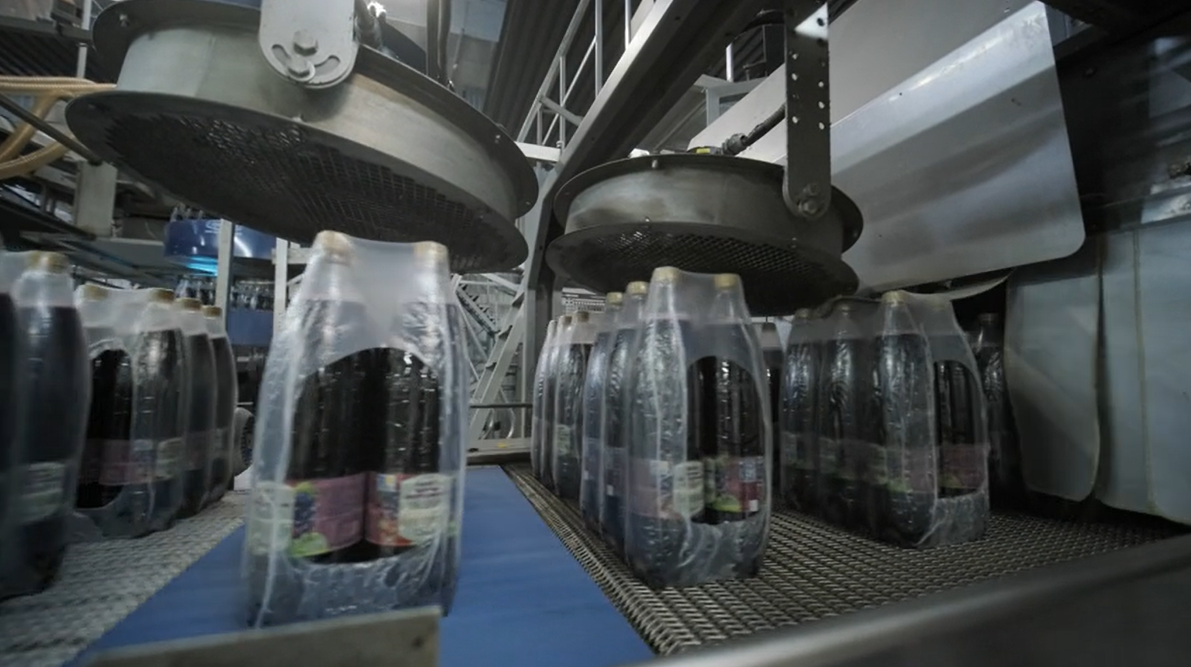
From our manufacturing and customer communication experience, packaging line conveyor requirements vary significantly depending on where in the sequence the equipment sits — upstream, mid-line, or downstream.
Upstream and Mid-Line Transfer Positions
Upstream of filling and sealing, conveyors typically handle empty containers, pouches, or preforms. These are lightweight, sometimes unstable products. A flat belt conveyor with a smooth or textured surface is commonly used here to provide controlled, low-vibration movement. Side guides are usually present to maintain lane alignment.
Mid-line positions — between filling and labeling, or between sealing and inspection — tend to involve products that are now full, sealed, and more dimensionally stable. This is where:
- Belt conveyors remain common for single-lane product flow
- Modular belt conveyors appear when the line requires curved transfers, wash-down compatibility, or easy maintenance access
- Timing and accumulation sections are introduced before equipment with fixed-cycle operation, such as labelers or vision inspection units
In food, beverage, and pharmaceutical packaging, hygiene requirements shape material selection. Stainless steel frames, FDA-compliant belt materials, and open-frame construction for cleaning access are standard expectations in these segments — not premium options.
Downstream and End-of-Line Positions
Downstream of primary packaging, product volume increases and physical handling demands shift. Individual units move into grouped packs, cartons, or trays. At this stage:
- Chain plate conveyors appear in heavier-duty transfer positions, particularly where glass bottles, cans, or rigid containers need stable, hard-surface support
- Modular belt conveyors are used where accumulation, lane merging, or diverting functions are needed before packing or palletizing
- Incline and decline belt conveyors bridge height differences between equipment levels
One thing we often observe in packaging inquiries: end-of-line positions are frequently where conveyor specifications become more project-specific. The product is fully formed, the pace is driven by downstream case packers or palletizers, and any mismatch in speed or surface type creates a visible bottleneck.
| Packaging Line Position | Common Conveyor Type | Typical Considerations |
|---|---|---|
| Empty container infeed | Flat belt conveyor | Low vibration, side guiding |
| Post-fill transfer | Belt or modular belt | Hygiene, speed matching |
| Pre-inspection accumulation | Modular belt with accumulation zones | Timing, back-pressure sensitivity |
| Label/coding section | Belt conveyor, narrow width | Precision pacing, surface stability |
| End-of-line grouping | Modular belt, chain plate | Lane merging, product weight |
| Incline to palletizer | Incline belt conveyor | Incline angle, slip resistance |
What Role Do Conveyor Systems Play in Warehouse Sorting Lines?
Warehouse sorting lines involve a different kind of product flow compared to packaging. Products are not being manufactured — they are being received, identified, routed, and directed to storage or outbound positions.2 The conveyor's job is to move items efficiently while supporting sortation decisions made upstream or in real time.
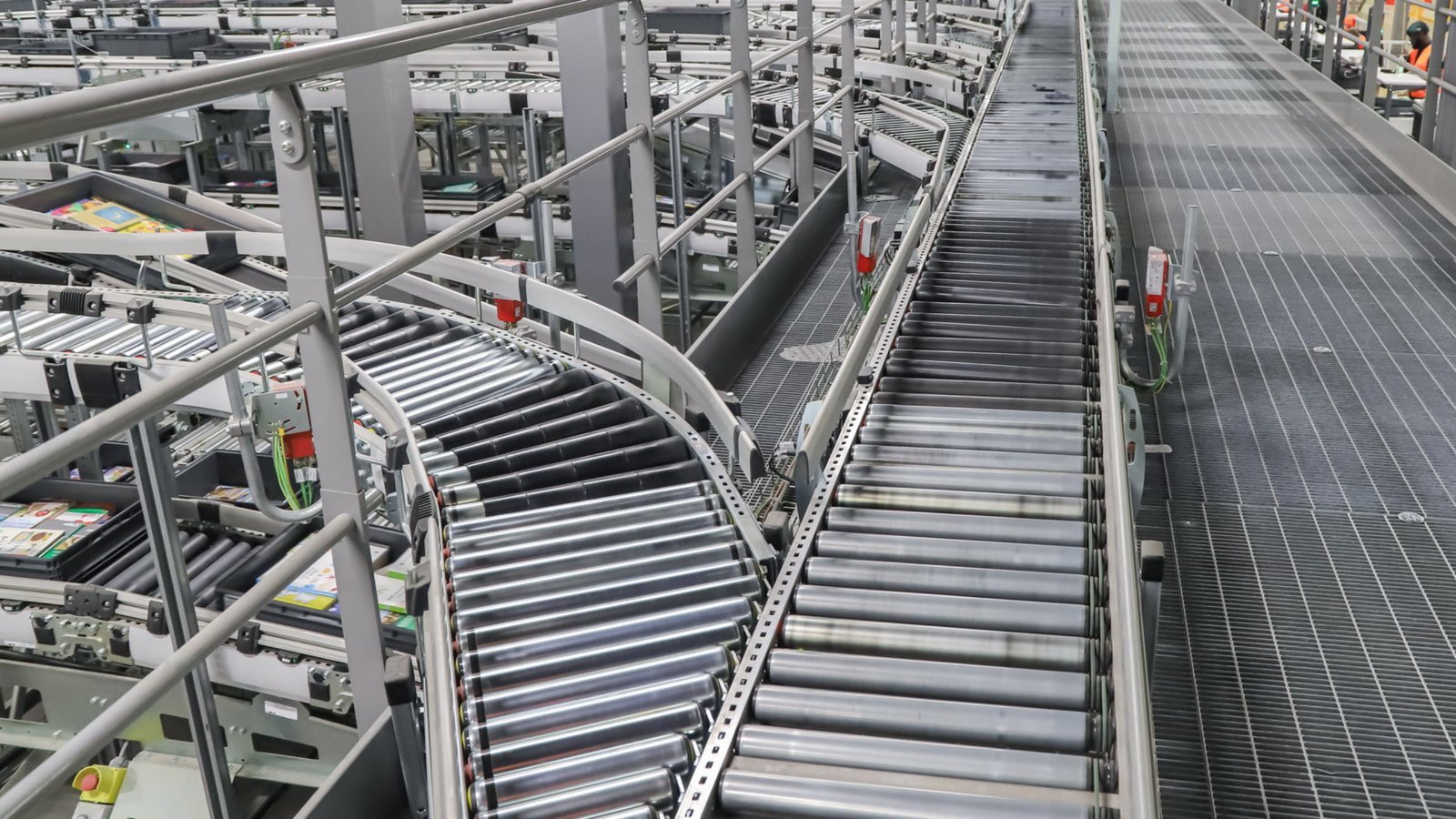
In warehouse sorting applications, conveyor systems form the physical backbone of item routing — moving cartons, totes, bags, or parcels from inbound receipt through identification, diverting, and lane assignment. The equipment emphasis shifts toward directional change, accumulation management, and sortation handoff rather than the process-paced transfer demands seen in packaging lines.
Inbound Receipt and Identification Zones
At the receiving end of a warehouse sorting line, conveyors move mixed product — often cartons or totes of varying sizes and weights — from unloading positions toward scan and identification points. Belt conveyors are the most common form here. They offer a stable, flat surface and are straightforward to integrate with barcode scanners or camera systems positioned above or beside the line.
Speed control and spacing between items are important at this stage. When items arrive clustered together, a sortation system downstream cannot process them accurately. So inbound conveyor sections often incorporate gap control — using variable speed segments to create consistent spacing before the identification point.
Accumulation and Buffering Positions
Between identification and sortation, or between sortation and packing stations, accumulation conveyors serve as the buffer that prevents the system from stalling. In common warehouse sorting applications, we see:
- Zero-pressure accumulation roller conveyors for carton and tote flow, where back-pressure between products is unacceptable
- Modular belt accumulation sections for softer packaging types where rollers may not provide sufficient surface contact
- Motor-driven roller (MDR) segments in more automated installations, though these fall into the broader automation system rather than standalone conveyor equipment
Accumulation is a function many buyers underestimate at the inquiry stage. The physical conveyor is relatively straightforward; the challenge is defining how much buffer volume the line actually needs, which depends on downstream processing speed and inbound arrival patterns.
Sortation Handoff and Lane Assignment
At the point where items are directed to specific lanes, chutes, or downstream positions, the conveyor form depends on the sortation mechanism integrated into the line. Diverter arms, pop-up transfers, and pivot wheels are common mechanisms. The conveyor supporting these positions needs to be compatible with the sortation equipment's footprint and speed requirements.
In common warehouse sorting applications:
- Belt conveyors act as the main trunk line carrying items to sortation points
- Short transfer conveyors or pop-up transfer units redirect items to perpendicular lanes
- Gravity or powered roller sections extend from sortation points into picking lanes or outbound staging areas
How Are Conveyor Systems Configured in Logistics and Distribution Lines?
Logistics and distribution environments share some characteristics with warehouse sorting — parcel and carton movement, directional changes, accumulation — but they operate at higher throughput volumes and with more emphasis on continuous flow. The conveyor system in a distribution hub or e-commerce fulfillment center is less forgiving of stoppages.
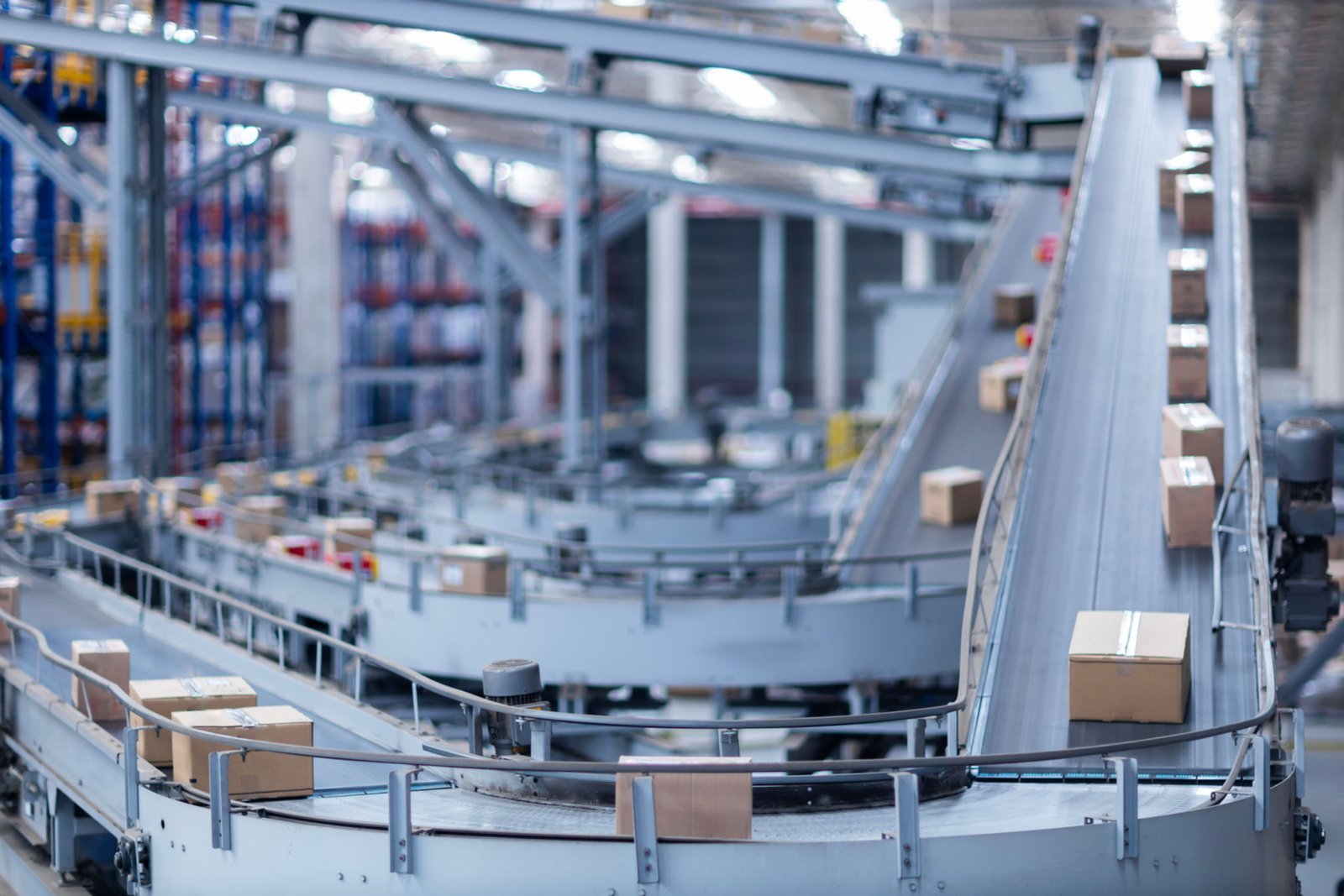
In logistics and distribution line applications, conveyor systems handle high-volume parcel and carton flow across longer distances, through multiple directional changes, and often across different floor levels. Belt conveyors, modular belt conveyors, and roller conveyor sections are commonly combined in a continuous network, with conveyor component durability and consistent performance being primary operational concerns.
Long-Distance and Multi-Level Transfer
In logistics facilities, conveyors move product over distances that packaging lines rarely approach. Incline and decline sections connect floor levels or mezzanines. The belt conveyor remains the dominant form for straight-run, long-distance transfer. Cleated belt conveyors handle inclined sections where product sliding would be a problem.
For curved sections between straight runs, modular belt conveyors are well suited — the interlocking modular belt construction accommodates radius curves without requiring separate transfer points. This matters in facilities where floor layout doesn't allow for purely straight-line routing.
Parcel and Irregular Item Handling
Logistics lines commonly handle a mix of product types — rigid cartons, polybag parcels, padded envelopes, and occasionally soft goods. This variability creates surface compatibility considerations:
- Flat belt conveyors handle most parcel types reliably, including lighter and softer items that don't convey well on rollers
- Roller sections are effective for dimensionally stable cartons but unsuitable for flexible parcels that can sag between rollers
- Modular belt conveyors offer an intermediate surface — more structured than a flat belt, easier to maintain in high-throughput environments
From our manufacturing experience, logistics conveyor inquiries often emphasize two practical concerns above others: belt or chain durability under continuous multi-shift operation, and ease of replacement when components wear. These are supply and maintenance considerations, not just initial selection criteria.
Merge and Diverge Points
Where multiple conveyor lines converge or diverge — for example, where lines from multiple picking zones merge into a single outbound line — the conveyor configuration becomes more complex. Merge points introduce the risk of product collision or jamming. Diverge points require precision in directing items to the correct downstream path.
At these positions, conveyor equipment alone rarely solves the routing logic — that involves control systems and sensing. But the physical conveyor at merge and diverge points must:
- Handle variable item spacing without back-pressure buildup
- Maintain item orientation through the transition
- Allow for easy access when jams occur
Modular belt conveyors are often preferred at these positions because they allow custom width, easy lane adjustment, and accessible maintenance compared to some roller-based alternatives.
Frequently Asked Questions
What types of conveyors are most commonly used in food packaging lines?
In food packaging lines, belt conveyors and modular belt conveyors are most commonly used for product transfer between stations. Chain plate conveyors appear in heavier-duty positions, particularly with cans or glass bottles. Material selection — FDA-compliant belts, stainless steel frames — is typically driven by hygiene and wash-down requirements specific to food processing environments.
Can the same conveyor system be used across packaging, sorting, and logistics applications?
Certain conveyor forms — flat belt conveyors and modular belt conveyors, in particular — appear across all three environments. However, the specific configuration, width, speed, frame design, and component materials differ by application. A belt conveyor used in a pharmaceutical packaging line will be specified differently from one used in a parcel logistics line, even if the operating principle is the same.
What conveyor components most affect performance and maintenance in high-throughput lines?
In high-throughput applications, belt or chain wear, sprocket condition, and wear strip and guide rail integrity are the components most directly tied to line continuity. These components are in constant contact with moving product or belt surfaces. Consistent manufacturing quality and reliable supply for these parts — rather than periodic replacement guesswork — is a practical operational concern for maintenance teams.
Are modular belt conveyors suitable for warehouse sorting applications?
Yes. Modular belt conveyors are used in warehouse sorting lines for accumulation sections, curved transfers, and positions where surface type matters for softer or irregular product. Their interlocking modular construction allows for width customization and easier section replacement, which suits the maintenance demands of continuously running sortation environments.
How does conveyor component sourcing affect logistics line operations?
In logistics and distribution operations running multiple shifts, conveyor belt, chain, and component wear is a recurring maintenance reality rather than an exceptional event. Reliable sourcing — consistent quality across repeated orders and predictable supply lead times — affects how maintenance teams plan and how quickly lines recover after a component replacement. This is an area where manufacturer-direct sourcing relationships are worth evaluating.
Conclusion
Across packaging, warehouse sorting, and logistics lines, conveyor systems serve different purposes depending on where they sit in the material flow. Packaging lines need process-paced transfer and hygiene-compatible equipment. Warehouse sorting lines demand accumulation management and reliable sortation handoff. Logistics lines require durable, continuous-flow equipment that holds up under high-throughput, multi-shift operation.
From our manufacturing and customer communication experience at Molytech, the most productive conversations start not with a product type but with a position — where in the line does this conveyor need to perform, and what is moving across it? If you're evaluating conveyor equipment or components for a packaging, sorting, or logistics application, we're glad to discuss what we manufacture and where our components are commonly applied. Reach out to Molytech's engineering team to start that conversation.
"Packaging machinery", https://en.wikipedia.org/wiki/Packaging_machinery. A general reference on packaging machinery identifies filling, sealing, labeling, inspection, cartoning, and palletizing as common operations in packaging lines, providing contextual support for the sequence described here. Evidence role: definition; source type: encyclopedia. Supports: A general packaging-machinery or packaging-line source should document common unit operations such as filling, sealing, labeling, inspection, cartoning, and palletizing.. Scope note: The exact order and inclusion of all stages vary by product and packaging format. ↩
"Chapter 3 1. What are the basic inbound operations of a ...", https://www2.isye.gatech.edu/~spyros/courses/IE6202/Fall-2002/Hw1-sol.pdf. Warehouse-management literature defines core warehouse operations as receiving, identification, storage, order processing, sorting, and shipping, supporting the article's distinction between warehouse sorting and manufacturing. Evidence role: definition; source type: education. Supports: A logistics or warehouse-management source should define core warehouse activities such as receiving, identification, sorting, storage, picking, and shipping.. Scope note: The source provides operational context and may not discuss conveyor equipment specifically. ↩