

Modular belting specifications look straightforward on paper — pitch, width, length — but buyers and maintenance teams consistently run into trouble when ordering replacements or sourcing for new builds. The wrong assumption about what any of these numbers means can result in a belt that won't fit, won't run, or won't last.
Pitch, width, and length in modular belting are not fixed universal numbers. They are specification decisions shaped by belt model, sprocket compatibility, mold structure, and the actual conveyor application. Pitch must be matched to the sprocket tooth spacing and belt model together. Width is typically built from a combination of module sizes. Length must align with pitch multiples, conveyor geometry, and take-up allowance.
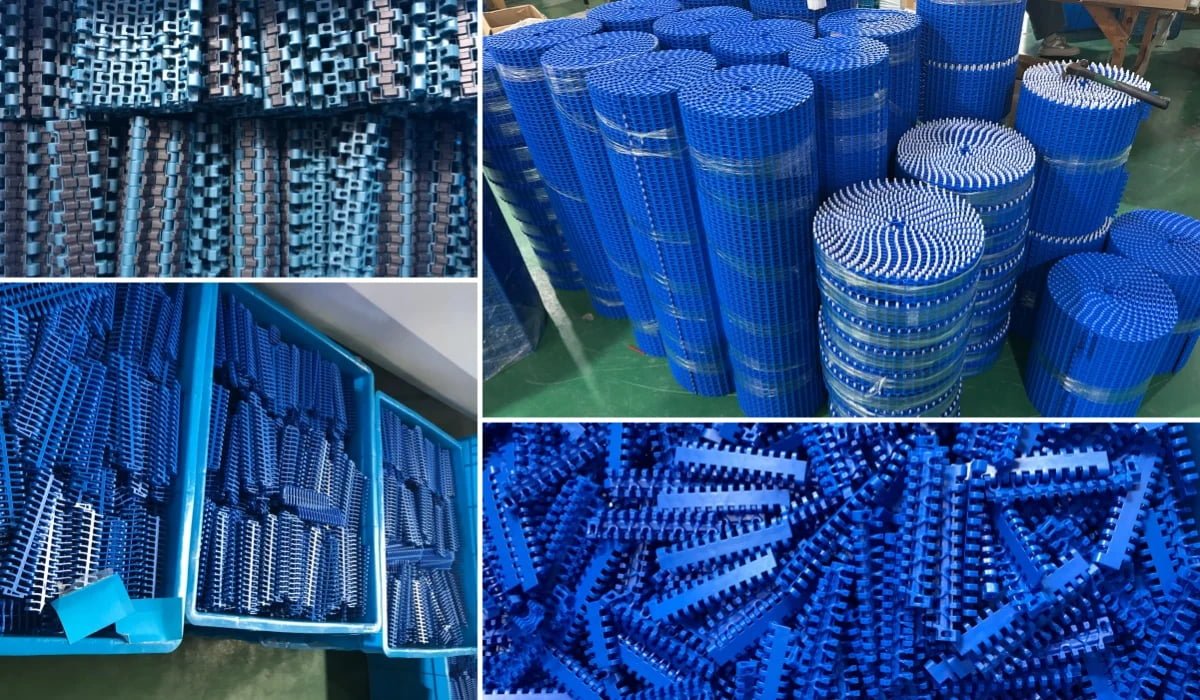
Understanding these three dimensions as a connected system — rather than three separate measurements — changes how you approach specification, procurement, and replacement. In our work at Molytech, we find that the most useful thing we can offer isn't a table of numbers, but an explanation of how those numbers are generated and what they depend on.
What Does Pitch Actually Mean in Modular Belting — and Why Does It Depend on the Belt Model?
Pitch sounds like the simplest dimension to confirm. It's just the distance between hinge points, right? In practice, we've seen orders go wrong precisely because pitch was pulled from one data source without checking whether it matched the actual belt model running on the conveyor.
In modular belting, pitch refers to the center-to-center distance between the hinge rod axes of consecutive rows. This distance must correspond to the tooth spacing of the sprocket driving the belt. Matching pitch correctly requires knowing both the belt model and the sprocket specification — pitch alone does not confirm compatibility.
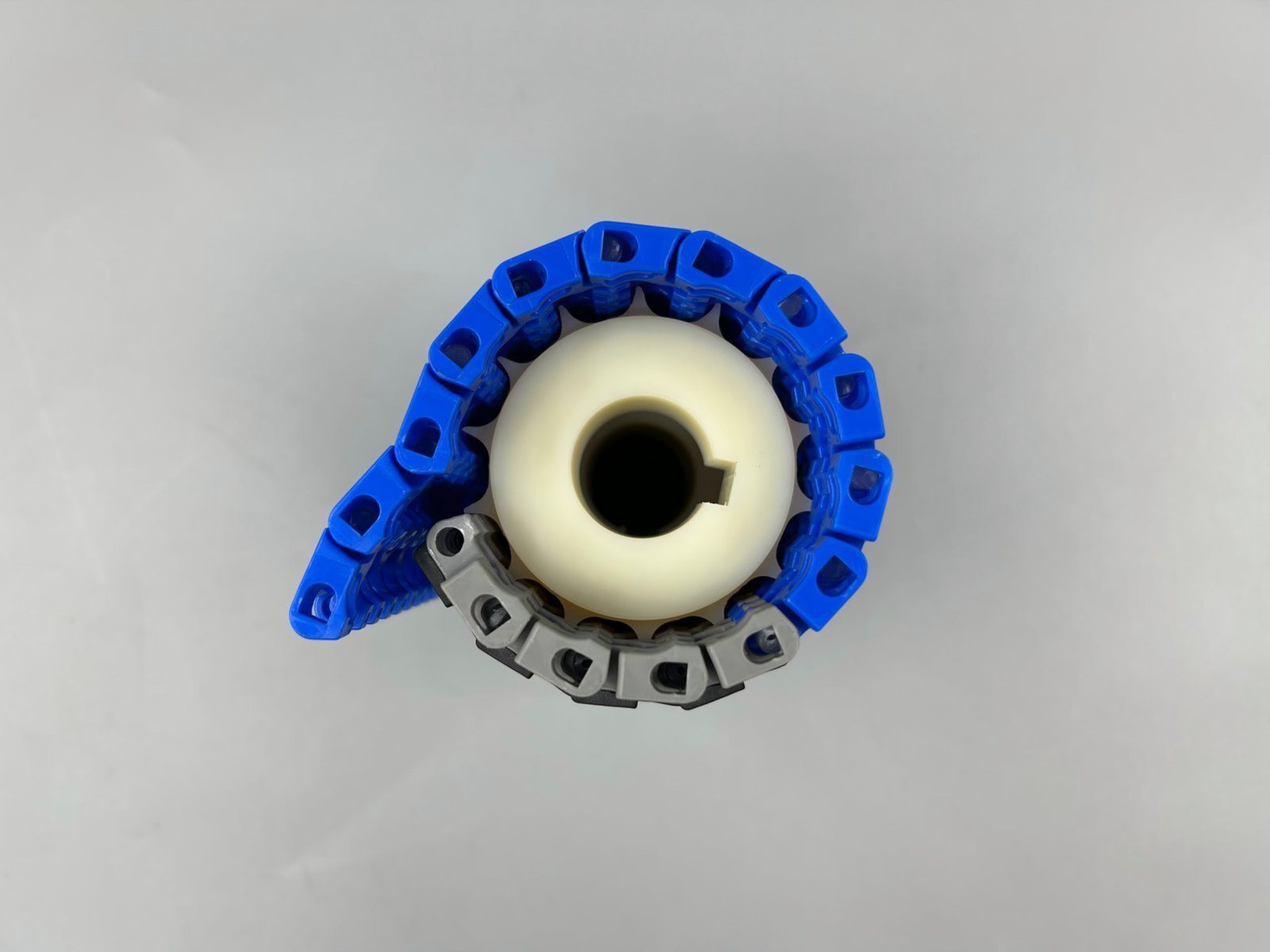
Pitch is the structural heartbeat of a modular belt system. Getting it right means understanding why the number exists in the first place.
Pitch as Part of the Belt-Sprocket Matching System
When we receive a replacement inquiry at Molytech, we never confirm pitch in isolation. The first question we ask is: what belt model, and what sprocket is it running on?
Here's why. The belt pitch must align precisely with the sprocket's tooth pitch. If the belt pitch is 25.4 mm, the sprocket must be designed with tooth spacing to match. If you substitute a belt with a nominally close but different pitch — say, a model with 25 mm center-to-center spacing — the mismatch creates uneven engagement, accelerated wear, and potential skipping under load.
Common pitch values we work with in modular belting include:
| Pitch (mm) | Typical Application Context |
|---|---|
| 12.7 mm | Fine pitch, small-radius turns, tight spacing |
| 19.05 mm | Light to medium duty, general conveying |
| 25.4 mm | Medium duty, food processing, general industry |
| 38.1 mm | Heavier loads, coarser product handling |
| 50.8 mm | Heavy-duty industrial applications |
Note: These values are examples from belt families we commonly work with. They are not exhaustive, and specific pitch values depend on the belt model and supplier. Different manufacturers may use different pitch standards.
Why "Same Pitch" Doesn't Guarantee Compatibility
This is something we emphasize with engineering teams and system integrators regularly. Two modular belts with identical pitch measurements are not necessarily interchangeable. The hinge structure, rod diameter, module thickness, open area percentage, and material composition all vary by model. A 25.4 mm pitch belt from one model family may have a completely different load profile, chemical resistance, or structural behavior than a 25.4 mm pitch belt from another.
In replacement situations, we always ask customers to share the old belt sample if available, or at minimum the belt model designation from the existing system. From that, we can confirm:
- Whether our available pitch matches the existing sprocket
- Whether the hinge geometry is compatible
- Whether the surface and material suit the product being conveyed
Pitch is the starting point for matching — not the finish line.
How Is Modular Belt Width Determined — and Why Does It Vary by Model?
Width is the specification dimension where our manufacturing experience adds the most practical value. Buyers often assume modular belt width is simply the full lateral dimension of the belt as measured from edge to edge. That's true in terms of the final result — but it doesn't explain how the width is built, or why certain widths are available for one model and not another.
Modular belt width is typically constructed by combining side modules and middle (infill) modules across the belt's running direction. Each belt model has its own mold widths for side and middle modules. The available widths depend on which combinations are possible within that model's module structure.
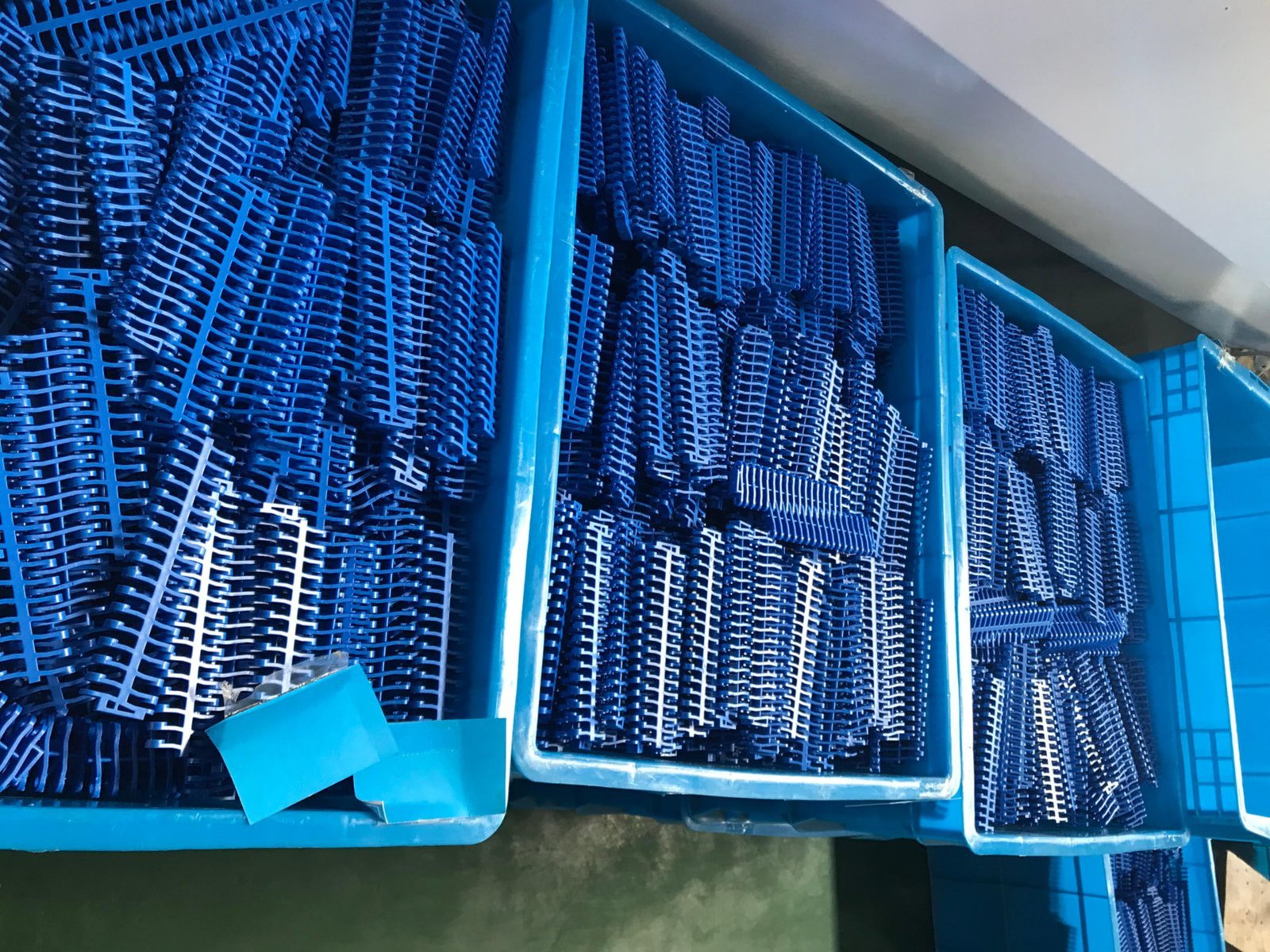
Understanding this building-block logic helps procurement teams communicate width requirements more accurately and avoid delays from unrealistic width expectations.
Side Modules, Middle Modules, and the Width Equation
Here's how we typically think through width in production. A modular belt row is assembled laterally using:
- Two side modules — one on each edge, providing the finished belt edge profile
- One or more middle (infill) modules — filling the center span between the two side modules
The width of a belt is therefore:
Belt Width = (Side Module Width × 2) + (Middle Module Width × N)Where N is the number of middle modules used.
Each belt model has its own mold-specific module widths. As an example to illustrate the logic — and not as a universal standard — some belt families we've worked with use side module widths of around 50.8 mm, 76 mm, or 85 mm, and middle module widths of approximately 82 mm, 152.4 mm, 170 mm, or 303 mm. These are model-specific examples. The actual dimensions for any given belt depend entirely on the belt series and the mold tooling used to produce it.
Why Width Customization Has Real Limits
When customers ask for a very specific width — say 620 mm — the first thing we check is whether that width is achievable within the module combinations available for the model they need. Sometimes the answer is yes, with a straightforward combination. Sometimes the nearest achievable width is 618 mm or 627 mm, depending on the mold structure.
This matters for a few reasons:
- Frame and guide rail clearance: A belt that is even a few millimeters wider than the frame allows can cause binding or derailment.
- Product containment: A belt narrower than expected may not support the product correctly at the edges.
- Side guard and wear strip fitment: These accessories are dimensioned to the belt width and must be re-evaluated if the width changes.
In our work, we ask customers for the usable conveying width and the total frame width before committing to a width specification. The belt width itself is one number — but it exists within a tolerance envelope defined by the mechanical assembly around it.
Custom Width Requests and OEM Considerations
For OEM and system integrator customers, we support custom width configurations within the constraints of our available tooling. If a project requires a width that sits between standard module combinations, we discuss the options clearly: whether an adjacent standard width is acceptable, or whether dedicated tooling is warranted for the production volume involved.
We've worked through this process with system builders who design conveyors for fruit sorting lines, pharmaceutical blister pack handling, and bakery cooling systems — applications where even a small width deviation affects product alignment or hygiene compliance. The manufacturing logic is the same across these cases; only the tolerance requirements differ.
How Is Modular Belt Length Calculated — and What Factors Affect It?
Length is the specification that most replacement buyers treat as the simplest to confirm: measure the old belt, order the same length. In practice, length calculation involves several variables that interact with the conveyor geometry and the belt's structural characteristics.
Modular belt length must be an even multiple of the belt pitch, determined by the conveyor's center-to-center distance, pulley or sprocket diameters, and the take-up allowance built into the conveyor frame. Simply measuring an old belt's length is a starting point — not a complete specification.
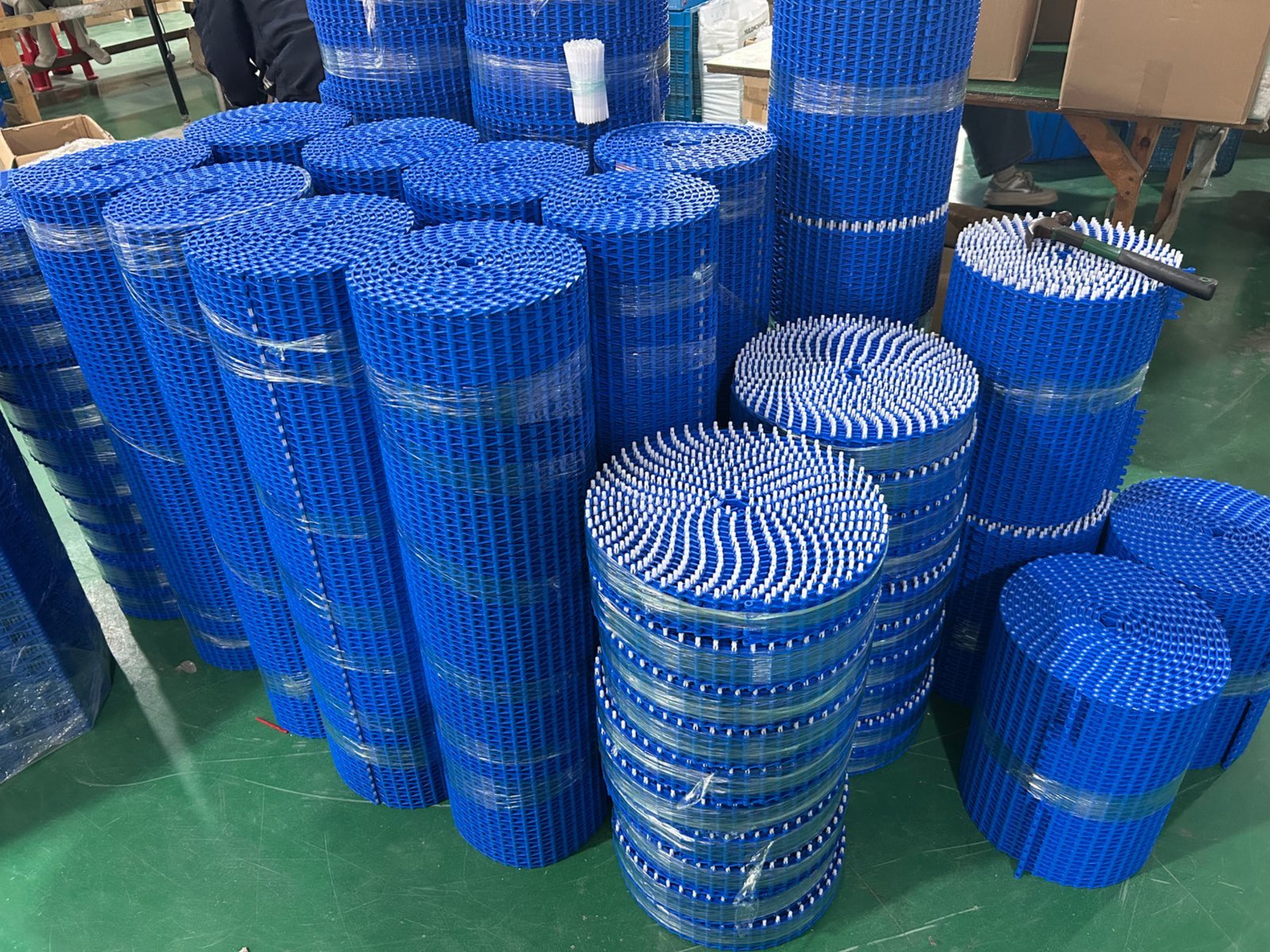
Getting length right is especially important because modular belts cannot be trimmed mid-row. The discrete, row-by-row structure means every length decision is a commitment to a specific row count.
Length as a Pitch Multiple
Because a modular belt is assembled row by row, the total belt length is always:
Belt Length = Number of Rows × PitchThis means that if a conveyor's geometry theoretically requires 1,847 mm of belt, but the pitch is 25.4 mm, the usable lengths are either 1,841.4 mm (72.5 rows — not valid) or the nearest whole-row multiples: 1,828.8 mm (72 rows) or 1,854.2 mm (73 rows).
The conveyor's take-up system must accommodate this rounding. Conveyors designed for modular belts typically include adjustable take-up positions precisely because length must fit the pitch multiple nearest to the nominal requirement.
What We Check When Confirming Length
In our specification confirmation process, we typically work through:
- Center-to-center distance of the conveyor (drive shaft to tail shaft)
- Sprocket pitch diameter at both ends — these determine the wrap circumference
- Incline or decline angle if present — this affects the effective path length
- Take-up range — how much adjustment is available in the conveyor frame
- Existing row count if the customer has the old belt and can count the rows
Counting rows directly from an old belt sample is often more reliable than measuring overall length with a tape, especially if the old belt has stretched, deformed at hinges, or been running under tension for an extended period.
Length Considerations for Specific Applications
For spiral conveyors, side-flexing belt systems, and incline applications, length calculation involves additional geometric considerations that go beyond flat conveyor arithmetic. In those cases, we ask for the full equipment drawing or a conversation with the equipment manufacturer's engineer before we commit to a length specification.
For straight, flat conveyors — the most common case we handle — the process above covers the majority of what's needed to arrive at a reliable length specification.
Frequently Asked Questions
Can I replace a modular belt just by matching pitch, width, and length?
Matching pitch, width, and length is a necessary starting point, but not a complete compatibility check. Belt model, hinge structure, material, and sprocket tooth geometry all affect whether the replacement will run correctly. In our experience, sharing the old belt model designation or a physical sample produces a more reliable result than dimensions alone.
Why can't I order a modular belt in any width I specify?
Modular belt width is built from combinations of side and middle modules, each with mold-specific dimensions. The achievable widths depend on which module combinations are possible for a given belt model. We work with customers to find the closest standard width combination or evaluate custom tooling when production volume justifies it.
Does the same pitch number mean two belts are interchangeable?
Not necessarily. Two belts with the same pitch may have different hinge geometry, module thickness, rod diameter, or material specifications. These differences affect load capacity, chemical resistance, and running behavior. Pitch matching confirms engagement compatibility with the sprocket — it does not confirm full belt-to-belt interchangeability.
What is the most reliable way to confirm modular belt length for a replacement order?
Count the rows on the existing belt if possible. Row count multiplied by pitch gives the most accurate length figure. If the old belt is unavailable, provide the conveyor's center-to-center distance, sprocket pitch diameters, and take-up range. These inputs together allow us to calculate the correct pitch-multiple length.
Can modular belt width be trimmed on-site to fit a narrower frame?
Modular belts can sometimes be narrowed by removing a middle module column, but only if the resulting width still allows for proper side module closure and hinge rod retention. This is a structural decision, not a field trim operation. We recommend confirming any width adjustment with the belt manufacturer before modifying a belt on-site.
Conclusion
Pitch, width, and length are the three foundational dimensions of any modular belting specification — but each one carries more complexity than the number alone suggests. Pitch is a system-level parameter that connects the belt to the sprocket and must be confirmed against the belt model. Width is a manufacturing output built from module combinations that vary by belt family. Length is constrained by pitch multiples and conveyor geometry, not just a measurement from the existing belt.
At Molytech, we work through these specifications with customers every day — in replacement projects, OEM builds, and system integrator sourcing situations. Our manufacturing background means we can validate compatibility before production, not after delivery.
If you're specifying or replacing modular belting and want a manufacturer who will check the details before committing to production, contact Molytech's engineering team. Share your belt model, conveyor dimensions, or existing sample — and we'll confirm the right specification for your application.
<!--[googlesitekit-end-of-content]-->