

When you're maintaining or planning a production line, you need to understand which chain conveyor fits your operation—not just the name, but how it actually moves product and what that means for your floor. After years of manufacturing conveyor components and working on customized projects across food processing, beverage, and bakery facilities, I've watched these decisions play out dozens of times. Choosing the wrong type means downtime, rework, and wasted budget. The right type keeps your line running and your maintenance schedule predictable.
Chain conveyors split into two main types in real production: roller chain conveyors and slat chain conveyors.1 Roller chain conveyors carry loads on roller elements driven by chain, used when products ride directly on rollers between guide rails. Slat chain conveyors attach flat slats to the chain, moving products on a continuous surface—this type divides further into plastic slat chain conveyors and stainless-steel slat chain conveyors, chosen based on hygiene standards, product contact, and cleaning frequency. Understanding each type means looking at the structure, the components that carry the load, and where that configuration works reliably over time.
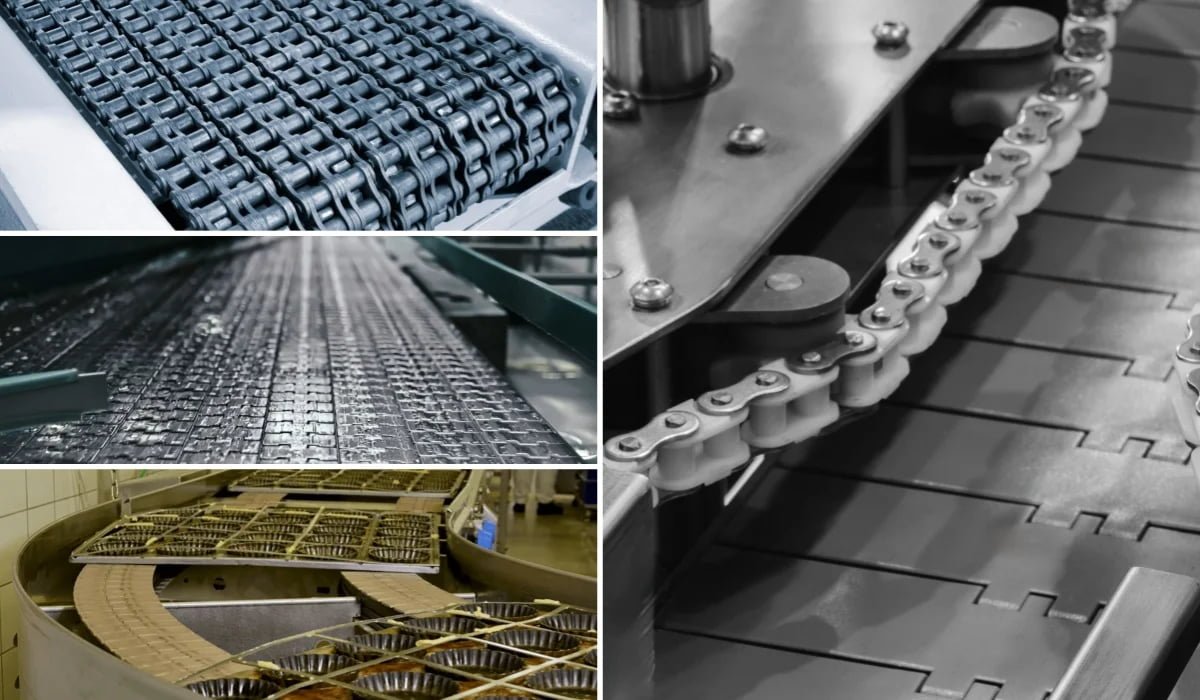
Most chain conveyor confusion disappears when you stop treating "type" as a label and start seeing the structure—what holds the product, what drives the movement, and what the floor crew deals with during cleaning and repair. In this article, I'll walk through the practical differences between roller chain conveyors and slat chain conveyors, show you the real-world context where each type shows up, and explain how the components you source affect performance, durability, and maintenance rhythm. This is the stuff I explain when someone sends a spec drawing and asks for parts—or when they're mid-project and realize the conveyor type they picked doesn't match their cleaning protocol.
What are roller chain conveyors and how are they used?
Roller chain conveyors appear throughout light and medium-load handling where products move smoothly between parallel guide rails. I've supplied drive chain, sprockets, and guide components for dozens of these systems, and the questions we get usually center on roller diameter, chain pitch, and how to keep side guidance accurate under continuous cycling.
Roller chain conveyors carry loads on cylindrical rollers mounted between two parallel chains.2 The chains ride on sprockets at each end, and the product rests on top of the rotating rollers. Drive force transmits through the chain, turning the rollers as the chain advances. This type works best when products have a stable base that contacts multiple rollers simultaneously, and when light to moderate speed and load fit the operation.
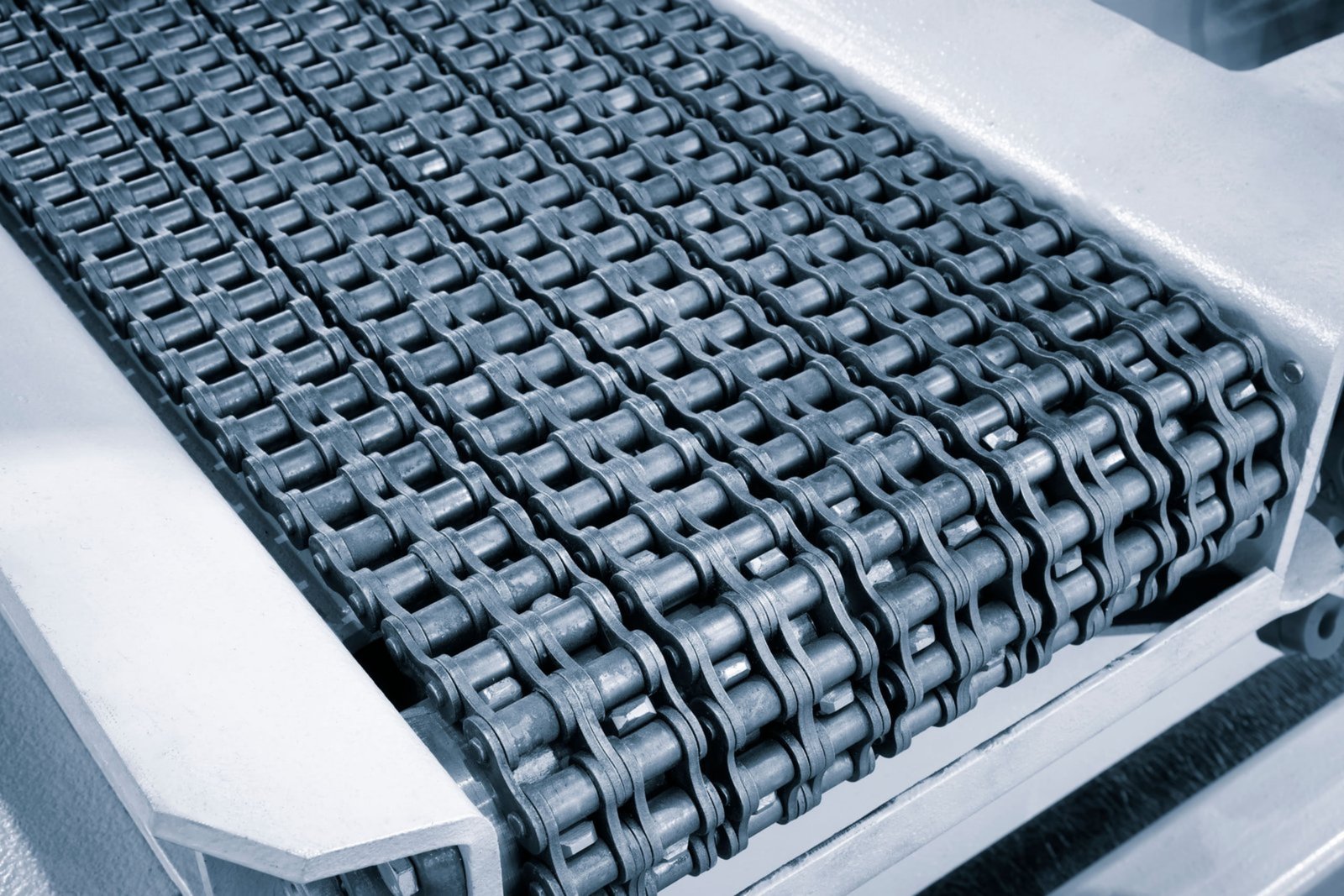
In many packaging lines, roller chain conveyors handle cartons, trays, or boxed products moving from one station to another. The product rides on top of the rollers, friction keeps it moving forward, and side guide rails prevent lateral drift. The chain pulls the rollers along, and the rollers rotate under the product weight, reducing drag compared to sliding contact. This setup keeps mechanical complexity low and allows operators to adjust guide rail spacing quickly when product dimensions change.
Structure and component layout
The core structure includes drive chain, load-bearing rollers, support frames, guide rails, sprockets, and tensioning hardware. The drive chain runs continuously around the conveyor loop, engaging sprockets mounted on drive and tail shafts. Rollers mount transversely between the two chains, either directly on axles integrated with chain links or on separate roller frames attached to the chain at fixed intervals.
Roller diameter and spacing depend on the smallest product base and the load distribution.3 Smaller, closely spaced rollers support lighter, unstable products; larger rollers with wider spacing handle heavier, stable loads. Chain pitch—the distance between chain link pins—affects roller spacing, drive torque requirements, and sprocket selection. Guide rails run along both sides of the conveyor, usually adjustable laterally, to keep products centered and prevent tipping or jamming.
We've manufactured sprockets and supplied chains for roller conveyors running 24/6 in bakery facilities, and the most common service issues we hear about involve chain wear, roller bearing failure, and guide rail misalignment. Proper chain tension, periodic lubrication, and accurate roller alignment reduce these problems significantly, but the design itself accepts these as routine maintenance points.
Where roller chain conveyors fit in production
Roller chain conveyors appear in packaging areas, cooling tunnels, accumulation zones, and transfer sections between automated equipment. The type works when products have rigid, flat bottoms and when the floor layout allows straight or slightly curved runs without steep inclines.
Food and beverage operations use roller chain conveyors for secondary packaging—cases, bundles, or trays—where the product already sits in protective packaging and doesn't require direct food-contact surfaces.4 In these areas, the conveyor doesn't need frequent wet cleaning or full washdown capability, and maintenance can happen during scheduled downtime without disrupting sanitary zones.
We've also supplied components for roller conveyors in light assembly and warehouse distribution, where the product variety and throughput rate demand flexibility and low maintenance overhead. The type doesn't excel in high-moisture environments or where fine debris accumulates around moving parts, but it handles moderate production volume reliably when kept clean and tensioned.
What are slat chain conveyors and how do they differ from roller conveyors?
Slat chain conveyors dominate primary production lines where product sits directly on the conveyor surface, hygiene standards matter, and cleaning cycles run frequently. I've spent years sourcing chain plates, plastic modular belts, and stainless-steel slat components for these systems, and the first question from any buyer is always about material compatibility, cleaning method, and expected service life under their specific product load.
Slat chain conveyors attach flat, overlapping slats to the drive chain, creating a continuous moving surface that carries products without gaps.5 The slats form the load-bearing plane, and the chain underneath provides drive force and structural support. This type works when products need stable, gap-free support, when hygiene and cleaning are priorities, and when the line must handle diverse product shapes, sizes, and weights without reconfiguration.
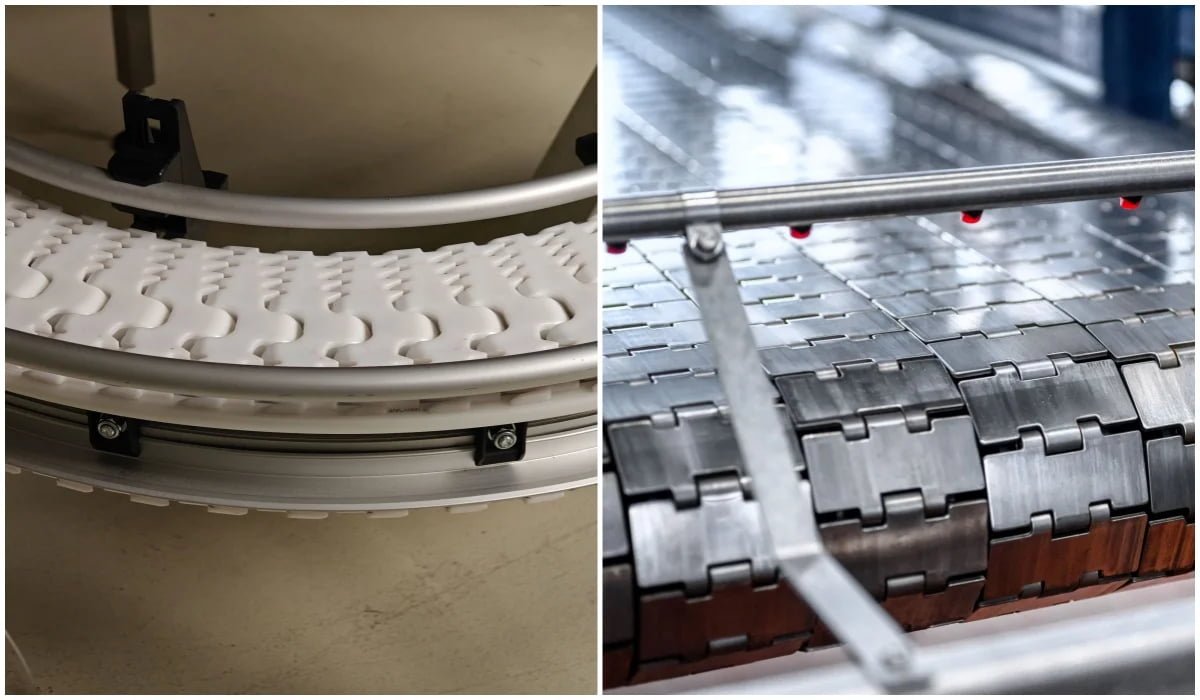
In food processing plants—baking, filling, cooling, and inspection stages—slat chain conveyors handle everything from raw dough to finished packaged goods. The continuous surface supports unstable products, prevents small items from falling through gaps, and offers a cleanable platform that meets sanitary design standards when properly specified. The chain runs in guide tracks or on wear strips, and the slats overlap slightly to maintain surface continuity during chain articulation around curves or elevation changes.
How plastic slat chain conveyors function in sanitary environments
Plastic slat chain conveyors use injection-molded plastic chain plates—typically POM (polyoxymethylene), PP (polypropylene), or PE (polyethylene)—joined with stainless-steel pins or integrated hinge structures. The plastic material resists corrosion, tolerates direct water spray and mild chemical cleaning agents, and runs quietly compared to metal-on-metal contact.
We manufacture and supply plastic chain plates in various widths, pitches, and surface textures, and every batch goes through dimensional checks to ensure consistent hinge tolerance and flat load surface. The material choice affects temperature tolerance, wear resistance, and compatibility with specific food products. POM offers higher strength and stiffness, suitable for moderate loads and speeds; PP and PE provide better chemical resistance and lower friction, preferred in wet or acidic environments.6
Plastic slat chain conveyors appear in bakery cooling conveyors, bottling lines, fruit sorting and packing, and pharmaceutical tablet handling. The continuous plastic surface minimizes particle entrapment, allows quick visual inspection, and supports CIP (clean-in-place) or manual washdown procedures without rust or oxidation concerns. Maintenance focuses on chain tension, wear strip replacement, and occasional pin inspection—plastic degrades under UV exposure and sustained high temperature, so operating environment monitoring matters.
Application context and design considerations
The type works best when product weight stays within the plastic material's load rating, typically light to moderate loads distributed across multiple slats. Line speeds usually remain below 60 meters per minute to control wear and noise. Curves and elevation changes require proper chain plate design—some plastic chains use curved flight profiles or side-flexing hinge structures to negotiate layout geometry without binding.
Hygiene design features include open hinge areas that drain easily, slat surfaces without deep grooves or pockets, and material formulations that resist bacterial adhesion. Buyers often ask whether plastic slats meet FDA, EU 10/2011, or NSF standards7; we provide material certifications and recommend verification for specific applications, but the responsibility for regulatory compliance always stays with the end user and their process validation.
We've supplied plastic chain plates for lines running three-shift operations in humid environments, and service life ranges from 18 months to over five years depending on load, speed, cleaning frequency, and maintenance discipline. The plastic surface wears gradually, and replacement happens in planned sections rather than catastrophic failure, which allows predictable spare parts budgeting.
How stainless-steel slat chain conveyors handle heavy-duty and high-hygiene applications
Stainless-steel slat chain conveyors use formed or machined stainless-steel plates—typically 304 or 316 grade—attached to heavy-duty chains with pins, brackets, or welded assemblies. The metal construction handles higher loads, elevated temperatures, aggressive cleaning chemicals, and abrasive product contact that would degrade plastic quickly.
We supply stainless-steel chain plates, brackets, and wear strips for conveyors in meat processing, canning lines, high-temperature baking ovens, and chemical-resistant pharmaceutical production. The stainless surface tolerates steam cleaning, caustic detergents, and repeated thermal cycling without dimensional change or material degradation. Maintenance focuses on lubrication (often food-grade), wear monitoring, and corrosion inspection in chloride-rich environments where even stainless steel can pit over time.
When stainless-steel slat conveyors make sense
The type appears when product weight exceeds plastic chain capacity, when operating temperature rises above plastic limits (typically above 80–100°C continuous), or when cleaning protocols demand high-pressure hot water, steam, or strong alkaline detergents. Stainless-steel slat conveyors also handle abrasive products—bone-in meat, shells, metal cans—that would scratch or gouge plastic surfaces rapidly.
| Feature | Plastic Slat Chain Conveyor | Stainless-Steel Slat Chain Conveyor |
|---|---|---|
| Load capacity | Light to moderate | Moderate to heavy |
| Temperature tolerance | Up to 80–100°C continuous | Up to 400°C+ depending on grade |
| Corrosion resistance | Excellent in most food acids and water | Excellent, but requires grade selection for chlorides |
| Cleaning compatibility | Water, mild detergents, some sanitizers | Steam, high-pressure water, caustic and acidic cleaners |
| Noise level | Low | Moderate to high |
| Wear indicators | Gradual surface wear, visible inspection | Localized wear on pins, brackets, and contact edges |
| Typical service life | 1.5–5 years depending on conditions | 5–10+ years with proper maintenance |
| Cost | Lower initial investment | Higher initial investment, lower lifetime replacement frequency |
The choice between plastic and stainless-steel slat chain conveyors comes down to load, temperature, cleaning intensity, and budget over the conveyor's full lifecycle. We've seen buyers choose plastic for cost reasons, then replace the entire system within two years because cleaning protocols damaged the material. We've also seen stainless-steel systems over-specified for light packaging lines, adding unnecessary weight and cost without operational benefit.
Component quality and maintenance rhythm
Both plastic and stainless-steel slat chain conveyors depend on the quality of chain plates, pins, sprockets, guide rails, and wear strips. Dimensional consistency matters—if chain pitch varies across a batch, the slats won't articulate smoothly around sprockets, leading to accelerated wear, noise, and eventual jamming. We control chain plate manufacturing with CNC machining and injection molding tolerances, and every batch goes through go/no-go gauging and surface finish inspection before shipping.
Maintenance rhythm differs between plastic and stainless-steel systems. Plastic slat conveyors require more frequent visual inspection, tension checks, and replacement of worn sections, but the work is lighter and faster. Stainless-steel systems need less frequent slat replacement, but pin and bracket wear monitoring demands closer attention, and lubrication schedules must stay consistent to prevent galling and seizing.
We recommend keeping spare chain sections, pins, and wear strips on-site for both types, and scheduling replacement during planned downtime rather than waiting for failure. Production continuity depends on predictable maintenance, not emergency repair.
What other chain conveyor variations appear in specialized applications?
Beyond roller chain conveyors and the two main slat chain conveyor types, you'll occasionally encounter variations designed for specific products or processes—drag chain conveyors for bulk material, apron conveyors for heavy mining or foundry work, and overhead chain conveyors for hanging products. These types show up less frequently in food, beverage, and light industrial production, but understanding their place helps when layout constraints or product characteristics push standard configurations to their limits.
Specialized chain conveyor types address narrow application niches—moving bulk solids, handling suspended loads, or operating in extreme environments—but they fall outside the day-to-day scope of most food and beverage production lines. When standard roller or slat chain conveyors don't fit, working with an engineering team to validate the alternative type against actual operating conditions prevents costly mismatches.
In my experience supplying components and custom conveyors, about 90% of projects settle on either roller or slat chain types after reviewing product dimensions, weight, hygiene needs, and floor space. The remaining 10% involve unusual product geometry, extreme temperature, or integration with legacy equipment that requires adapting a less common conveyor type. Those projects take longer, require more technical back-and-forth, and often involve prototype testing before committing to full production.
Frequently Asked Questions
What is the main difference between roller chain conveyors and slat chain conveyors?
Roller chain conveyors carry products on rotating rollers between parallel chains, while slat chain conveyors attach flat slats to the chain to create a continuous moving surface. Roller types work best for stable, boxed products; slat types handle diverse shapes, provide gap-free support, and meet higher hygiene standards.
Can plastic slat chain conveyors handle wet cleaning?
Yes, plastic slat chain conveyors tolerate water spray and mild chemical cleaning agents. Material choice—POM, PP, or PE—affects chemical resistance and temperature limits. Always verify cleaning agent compatibility and temperature exposure with material certifications before specifying plastic chains for wet or CIP environments.
When should I choose stainless-steel slat chain conveyors over plastic?
Choose stainless-steel slat chain conveyors when product weight exceeds plastic capacity, operating temperature exceeds 100°C, or cleaning protocols require steam, high-pressure hot water, or aggressive detergents. Stainless steel also handles abrasive product contact better than plastic.
How do I determine the right chain pitch and slat width for my conveyor?
Chain pitch depends on product base dimensions, load distribution, and required drive torque. Slat width depends on product width and lateral stability needs. Work with engineering data from component suppliers, account for product overhang and guide rail clearance, and confirm sprocket availability for the selected pitch.
What maintenance intervals apply to chain conveyors?
Maintenance intervals vary by conveyor type, load, speed, and operating environment. Typical schedules include daily visual inspection, weekly tension checks, monthly lubrication (if applicable), and quarterly wear measurement on chains, slats, sprockets, and wear strips. Replace worn components during planned downtime to avoid emergency stops.
Conclusion
Chain conveyors divide practically into roller chain conveyors and slat chain conveyors, with slat types further split into plastic and stainless-steel versions based on load, temperature, hygiene, and cleaning intensity. Roller chain conveyors handle stable, boxed products with minimal complexity; plastic slat chain conveyors offer cost-effective, hygienic surfaces for light to moderate loads; stainless-steel slat chain conveyors deliver durability and cleaning tolerance for heavy-duty and high-temperature production. Understanding these types means looking past names and evaluating structure, components, and application context—what your product weighs, how you clean, and what your floor crew maintains daily. At Molytech, we manufacture and supply the conveyor components—chain plates, chains, sprockets, guide rails, wear strips—that make these systems run reliably, and we work with clients to match component specifications to real operating conditions. If you're selecting or maintaining chain conveyors and need technical support or quality components, reach out—we'll work through your application details and provide accurate, production-tested recommendations.
<!--[googlesitekit-end-of-content]-->
"Figure 3 - from Study of Different Types of Conveyor System", https://www.academia.edu/figures/36240428/figure-3-structural-diagram-mostly-slat-conveyors-are-used. Engineering conveyor references classify chain conveyors by their conveying surface and load-support mechanism, including roller-chain and slat-chain arrangements; this supports the article's practical grouping, although it does not exclude other specialized chain conveyor categories. Evidence role: general_support; source type: institution. Supports: Industry or engineering references commonly distinguish chain conveyors by the load-carrying element, including roller and slat configurations.. Scope note: Contextual support only, because classifications are not universally limited to two types. ↩
"Roller chain", https://en.wikipedia.org/wiki/Roller_chain. Mechanical-handling references describe roller chain conveyors as chain-driven systems in which rollers provide the load-bearing surface for unit loads; this supports the structural definition used here. Evidence role: definition; source type: education. Supports: Roller chain conveyors are defined by chain-driven roller assemblies that support and move unit loads.. ↩
"(PDF) Gravity Roller Conveyor Design - Academia.edu", https://www.academia.edu/33110622/Gravity_Roller_Conveyor_Design. Conveyor design references note that roller spacing and roller diameter must be chosen with regard to the conveyed item's base dimensions and load distribution; this supports the article's design criterion. Evidence role: mechanism; source type: education. Supports: Roller spacing and roller size are selected so that products are adequately supported and loads are distributed safely.. ↩
"FDA Food Code 2022: Full Document", https://www.fda.gov/media/164194/download. Food-equipment hygiene guidance distinguishes food-contact surfaces from non-food-contact surfaces used for packaged products, supporting the contextual claim that secondary-packaging conveyors often face different sanitary requirements than direct product-contact conveyors. Evidence role: general_support; source type: government. Supports: Food-processing guidance distinguishes direct food-contact equipment surfaces from non-food-contact or packaged-product handling areas.. Scope note: This supports the sanitary distinction, not the market frequency of roller chain conveyors in every food and beverage facility. ↩
"(PDF) Analysis of optimization possibilities of slat conveyor drives", https://www.academia.edu/105239406/Analysis_of_optimization_possibilities_of_slat_conveyor_drives. Engineering references describe slat conveyors as chain-driven systems with slats or plates forming the load-carrying surface, supporting the article's definition of a continuous moving surface. Evidence role: definition; source type: education. Supports: Slat chain conveyors are defined as conveyors in which slats or plates attached to chains form the carrying surface.. ↩
"Plastics Collection - Materials", https://digitalcollections.syr.edu/plastics-collection/materials. Polymer property references report that POM generally exhibits relatively high stiffness and strength among engineering plastics, while PP and PE are widely noted for chemical resistance and low-friction behavior, supporting the article's material-selection comparison. Evidence role: general_support; source type: education. Supports: Published materials data compare POM, PP, and PE in terms of stiffness, strength, chemical resistance, and friction characteristics.. Scope note: The comparison is general because exact properties vary by grade, fillers, temperature, and exposure conditions. ↩
"Food Packaging & Other Substances that Come in Contact ...", https://www.fda.gov/food/food-ingredients-packaging/food-packaging-other-substances-come-contact-food-information-consumers. Authoritative regulatory sources identify FDA food-contact requirements and EU Regulation No. 10/2011 for plastic food-contact materials, while NSF standards address sanitary food-equipment materials; these sources support the compliance frameworks referenced here. Evidence role: definition; source type: government. Supports: FDA and EU rules regulate food-contact materials, and NSF standards address food equipment sanitation and materials.. Scope note: The citation would identify applicable frameworks, not determine compliance for any specific conveyor component. ↩