

If you work around conveyor systems, you have probably heard both terms used. Sometimes they are used interchangeably, which creates confusion.
A belt conveyor uses a continuous belt as the moving surface to carry products. A chain conveyor uses chains, chain plates, or chain-driven structures to move products or carriers. The core difference is the conveying medium — one uses a belt, the other uses a chain-based surface.
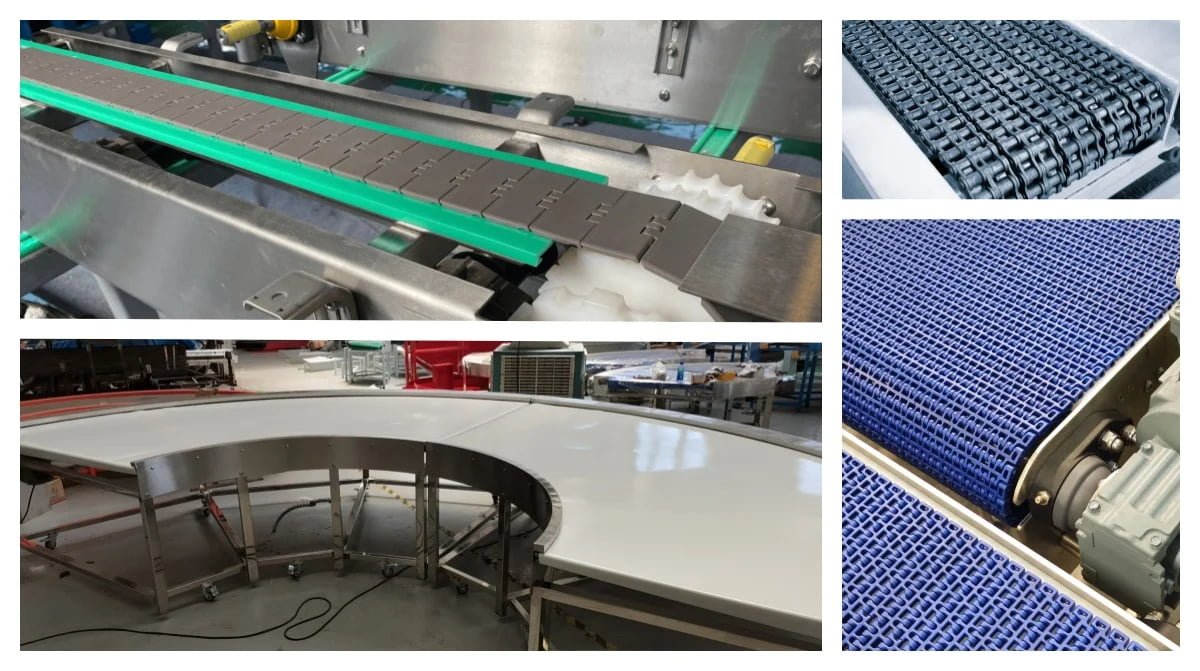
Both types of conveyors move products from one point to another. But the way they do it is different. Understanding that difference starts with looking at how each one is built and how the conveying surface works.
What Does a Belt Conveyor Actually Look Like?
You see belt conveyors everywhere, but it is easy to overlook what makes them a specific type of machine.
A belt conveyor consists of a continuous loop of belt material stretched over two or more rollers.1 A drive roller at one end pulls the belt forward. Products sit on top of the belt and move with it as the belt travels along the frame.
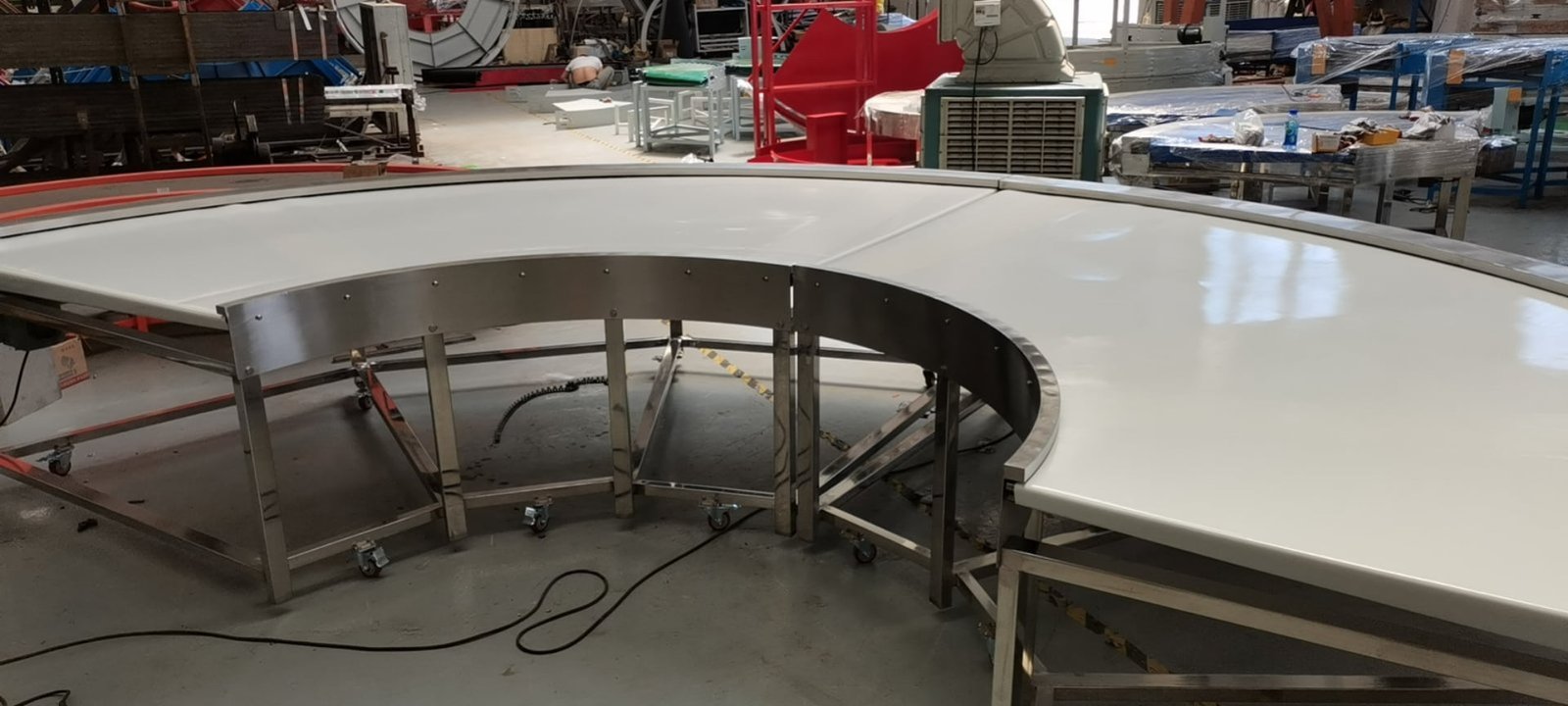
The belt itself can be made from many materials. Flat rubber belts are common in general industrial use. PVC and PU belts are widely used in food and packaging environments. Fabric-reinforced belts are used where the belt needs to carry more load without stretching.
The belt wraps around the drive roller at the head end, travels underneath the frame along the return path, and then comes back around. The product only contacts the top surface of the belt. The belt moves as one continuous piece, so the conveying surface is smooth and uninterrupted.
Key Structural Features of a Belt Conveyor
| Component | Role |
|---|---|
| Drive roller | Pulls the belt forward via friction or direct contact |
| Tail roller | Supports the belt at the other end and maintains tension |
| Idlers / support rollers | Hold the belt flat along the carrying surface |
| Frame | Supports the full structure |
| Belt | The conveying surface itself |
The belt is flexible. It can run in a straight line, and with the right design, it can also run on a slight incline or decline. The surface contact between the product and the belt is continuous and even, which is one reason belt conveyors are often associated with smooth, gentle product movement.2
What Does a Chain Conveyor Actually Look Like?
The term "chain conveyor" covers more than one type of machine. This is where confusion often starts.
A chain conveyor is any conveyor that uses a chain-based mechanism as the main drive or conveying surface.3 This includes traditional drag chain conveyors, chain plate conveyors, and modular belt systems. They are different in structure, but all rely on chain or chain-like components at the core.
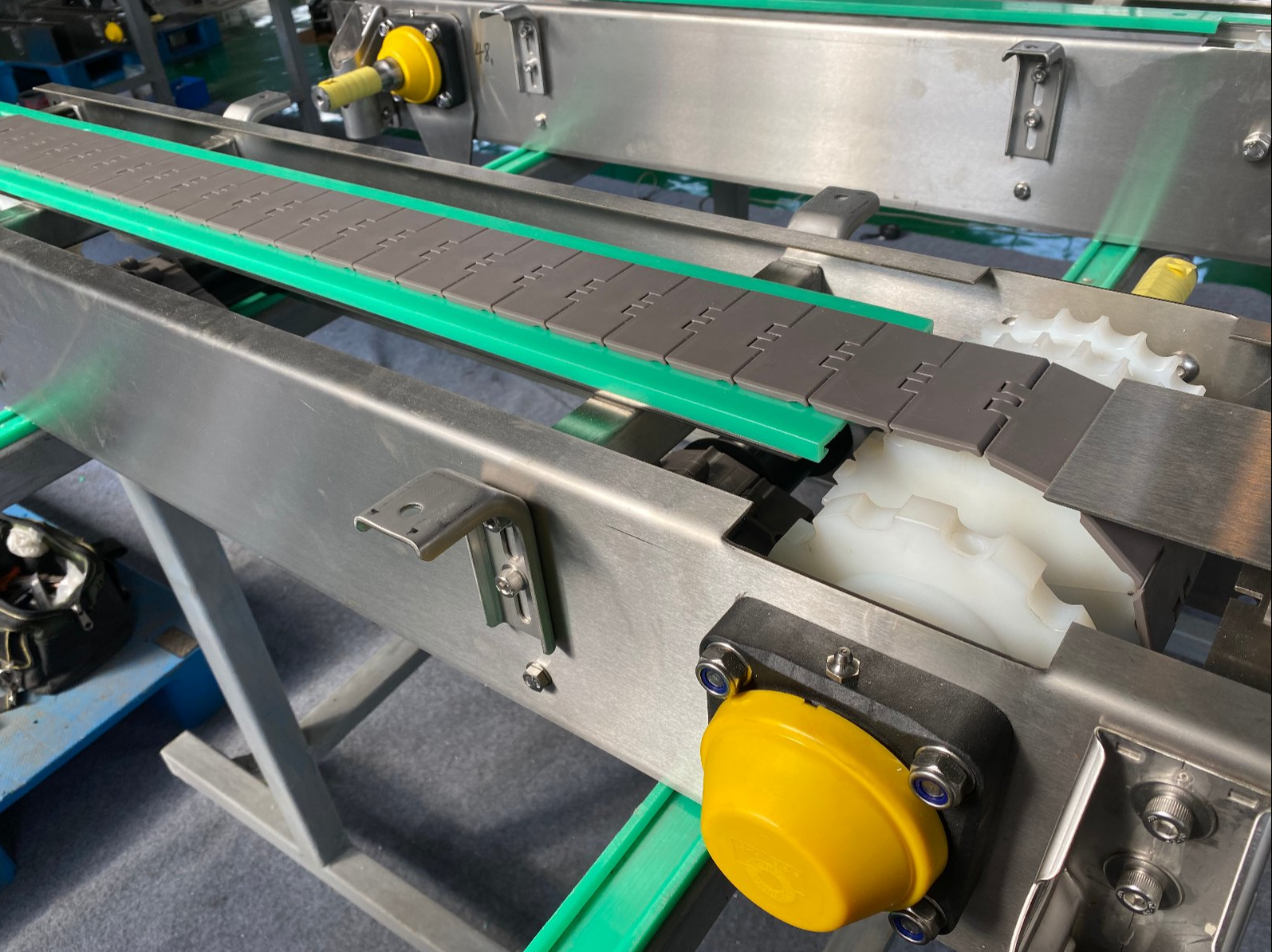
It helps to separate the three most common versions so they are not mixed together.
Three Common Types Within the "Chain Conveyor" Category
Traditional drag chain conveyors use one or more bare chains running along the frame. Products are either dragged along or placed on a flat surface that the chains pull. These are often used in heavy-duty applications where the product itself rests on the chain or on a connected platform.
Chain plate conveyors use flat metal or plastic plates that are attached to the chain links. The plates form a solid, flat surface. Products sit on top of the plates. The chain drives the plates forward in a loop, similar in principle to how a belt conveyor moves, but using a rigid plate-and-chain structure instead of a flexible belt.
Modular belt systems use interlocking plastic modules that are assembled into a flat conveying surface. These modules are driven by a chain or by sprockets that engage directly with the module links. The result looks more like a belt from the outside, but the internal structure is chain-driven and modular.
| Type | Conveying Surface | Drive Mechanism |
|---|---|---|
| Drag chain conveyor | Chain itself or attached platform | Chain pulled by sprocket |
| Chain plate conveyor | Rigid metal or plastic plates on chain | Chain and sprocket |
| Modular belt conveyor | Interlocking plastic modules | Sprocket teeth engaging module links |
Each of these is technically a chain conveyor in the broad sense. But their structures and applications are not identical, so the term "chain conveyor" alone does not give a complete picture.
How Do the Two Structures Differ at Their Core?
Now that both types are defined, the structural differences become clearer side by side.
The main structural difference is that a belt conveyor uses a single continuous flexible surface, while a chain conveyor uses a linked, segmented, or modular surface driven by chains and sprockets. This affects how the surface engages the drive, how products are supported, and how the conveying surface returns.
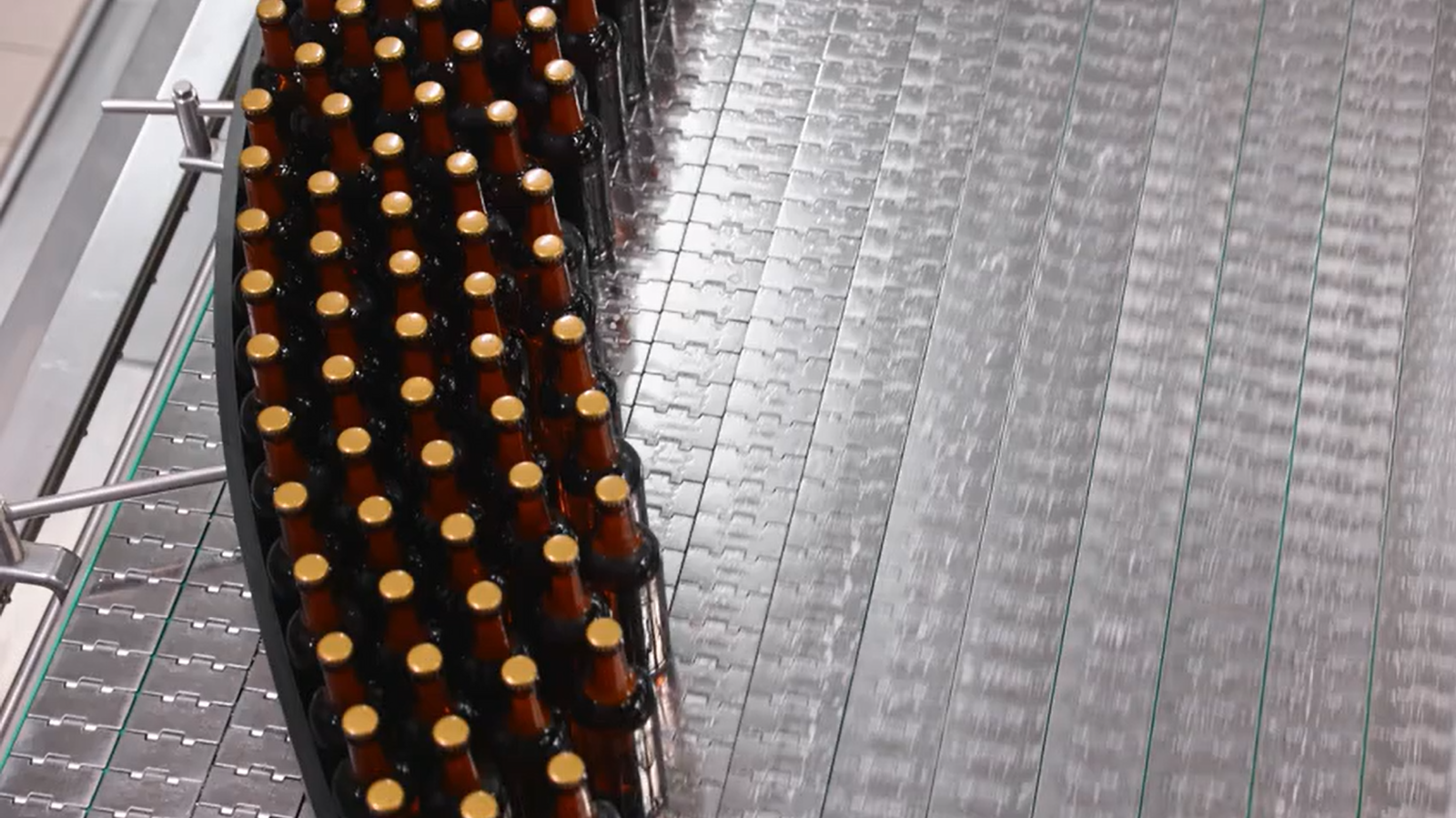
A belt relies on friction between the belt and the drive roller to move forward. The drive roller turns, friction grips the belt, and the belt moves. If there is too little tension or too much load, the belt can slip on the roller.4 This is why belt tension management matters in belt conveyor design.
A chain or modular belt system does not rely on friction in the same way. The sprocket teeth fit into the chain links or module slots and push them forward directly. This is called positive drive.5 The chain cannot slip past the sprocket the way a belt can slip past a roller.6 The engagement is mechanical and defined.
Structural Comparison at a Glance
| Feature | Belt Conveyor | Chain / Chain Plate Conveyor |
|---|---|---|
| Conveying surface | Continuous flexible belt | Linked plates, modules, or bare chain |
| Drive method | Friction between belt and drive roller | Positive drive via sprocket and chain |
| Surface flexibility | High — bends around rollers smoothly | Low to medium — rigid or semi-rigid sections |
| Return path | Belt loops underneath the frame | Chain or plate loops underneath the frame |
| Surface continuity | Seamless and smooth | Segmented — individual links or plates |
| Drive slip risk | Possible under high load or low tension | Minimal — mechanical engagement |
The return path is also worth noting. In both systems, the conveying surface must travel back to the start after it reaches the end of the run. In a belt conveyor, the belt bends around the tail roller and runs flat underneath the frame back to the drive end. In a chain plate or modular belt conveyor, the plates or modules also loop underneath, but the structure is heavier and often requires guide rails or a dedicated return track to support the chain.
This means chain-based systems generally require more structural support along the full length of the conveyor, especially for wider or heavier designs. Belt conveyors can often use lighter frames with simple roller supports along the return path.
How Do They Differ in Operating Characteristics?
Structure affects behavior. The two systems move in different ways during operation.
Belt conveyors tend to produce smooth, continuous motion because the belt surface has no interruptions. Chain and plate conveyors can produce slight variations in motion depending on chain pitch and sprocket size, a phenomenon known as chordal action in chain-driven systems.
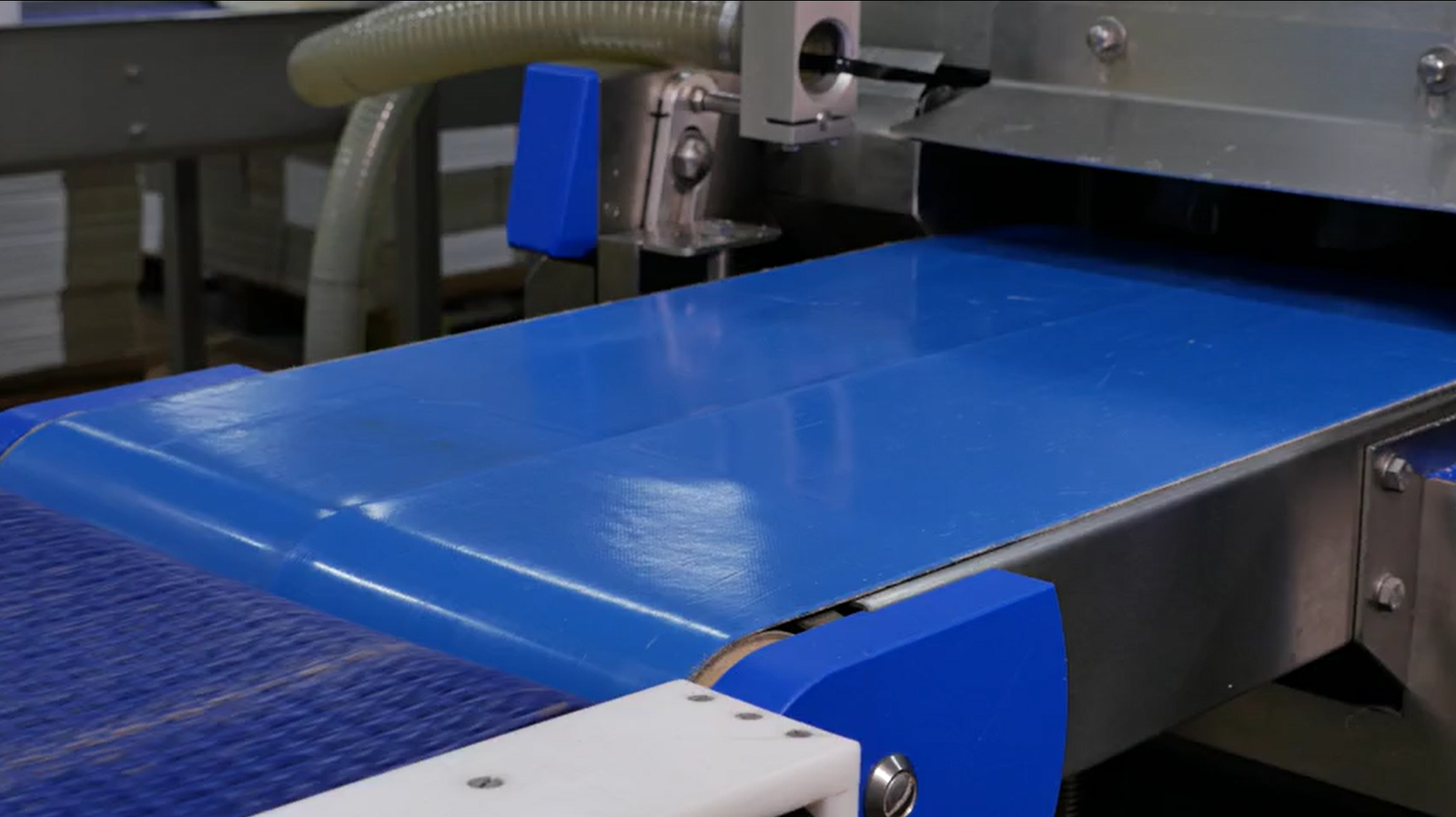
A belt surface is seamless. There are no joints, no links, and no gaps. When a product sits on a belt conveyor and the belt moves, the product experiences a smooth, even surface beneath it at all times. The belt also has some natural flexibility and compliance, which can absorb minor surface irregularities.
A chain plate surface is made of individual rigid plates. Each plate has a defined width and connects to the next via the chain link. The surface is flat and functional, but it is assembled from parts rather than formed as one piece. For most products, this makes no practical difference. But the distinction matters when you are thinking about how the surface is constructed and maintained.
Operating Characteristic Comparison
| Characteristic | Belt Conveyor | Chain Plate / Modular Belt Conveyor |
|---|---|---|
| Surface texture | Smooth and continuous | Segmented, flat plates or modules |
| Motion consistency | Even and continuous | Generally smooth, slight chordal variation possible |
| Noise level at speed | Generally lower | Can be higher depending on chain type and speed |
| Handling of wet or washed environments | Depends on belt material | Chain and plastic plates handle wash-down better in many designs |
| Repairability | Belt replaced as full unit or spliced | Individual plates or modules can be replaced separately |
One practical note on repairability: if a belt conveyor belt is damaged, you typically replace the full belt or splice it at the damage point. If a chain plate conveyor loses a plate or a module, you can often remove just the damaged section and replace that part. This modular nature is one reason chain plate and modular belt systems are common in food processing environments where regular cleaning and maintenance are part of the routine.
Conclusion
A belt conveyor uses a continuous flexible belt driven by roller friction. A chain conveyor uses a chain-based surface driven by sprocket engagement. The difference is structural — in the conveying medium, the drive method, and how the surface is assembled.
"Determination of resistance to motion during operation of belt ...", https://www.academia.edu/114245009/Determination_of_resistance_to_motion_during_operation_of_belt_conveyor. An engineering reference defines a belt conveyor as a continuous belt loop supported and driven by rollers or pulleys, which supports the description of the basic belt-conveyor structure. Evidence role: definition; source type: education. Supports: The source should define a belt conveyor as a continuous belt or loop carried over rollers or pulleys.. ↩
"Conveyor Belt Research Papers - Academia.edu", https://www.academia.edu/Documents/in/Conveyor_Belt/TopPapers. A materials-handling reference explains that belt conveyors provide continuous support to the load, which is consistent with their use for comparatively smooth and gentle product movement. Evidence role: mechanism; source type: education. Supports: The source should explain that belt conveyors provide continuous support or a smooth conveying surface that can reduce impact or disturbance to conveyed goods.. Scope note: The support is contextual because actual gentleness depends on belt speed, transfer points, product geometry, and conveyor design. ↩
"material selection process of roller chain conveyor - Academia.edu", https://www.academia.edu/37274108/MATERIAL_SELECTION_PROCESS_OF_ROLLER_CHAIN_CONVEYOR. A general technical reference defines chain conveyors as conveying equipment that uses chains to move products or load carriers, supporting the article’s broad definition of the category. Evidence role: definition; source type: encyclopedia. Supports: The source should define chain conveyors as conveyors that use one or more chains to move products or carriers.. ↩
"[PDF] DYNAMIC MODELING OF BELT DRIVES USING THE ELASTIC ...", https://repository.gatech.edu/bitstreams/adb9182c-3f72-4593-9437-4ea7e4425f6c/download. Belt-drive mechanics literature shows that traction depends on belt tension and friction at the drive pulley, so inadequate tension or excessive load can produce belt slip. Evidence role: mechanism; source type: paper. Supports: The source should show that frictional belt drives depend on adequate tension and that insufficient tension or excessive resistance can lead to slip.. ↩
"Chain drive", https://en.wikipedia.org/wiki/Chain_drive. A power-transmission reference defines positive drive as motion transmitted through mechanical tooth engagement, such as sprocket teeth engaging chain links, which supports the terminology used here. Evidence role: definition; source type: education. Supports: The source should define positive drive as mechanical engagement between teeth and links or slots, as in chain and sprocket systems.. ↩
"Sprocket and Chain Drive: How It Works, Diagram & Examples", https://www.firgelliauto.com/blogs/mechanisms/sprocket-and-chain-drive?srsltid=AfmBOoowqDiRKmHsNj9o0glrpKtUBiVm3HMK0hEU2KsdcVVXn5Qky01h. A mechanical power-transmission source explains that chain drives are positive-drive systems in which sprocket engagement largely prevents slip, unlike friction belt drives. Evidence role: mechanism; source type: education. Supports: The source should explain that chain drives transmit motion through sprocket engagement and are generally non-slip compared with friction belt drives.. Scope note: The support concerns normal operating conditions; chain drives can still malfunction through wear, derailment, poor tensioning, or tooth jumping. ↩