

Conveyor belts transport a wide variety of products across production facilities — from baked goods and beverage bottles to packaged fruits or medical items.
While belt material often attracts attention, the surface pattern is equally significant.
The design of a belt’s surface determines how products are positioned, how liquids drain, and how easily the belt can be cleaned.
This article explains the main types of conveyor belt surfaces and outlines how each performs in different industrial applications.
Basic Types of Conveyor Belt Surfaces
Smooth Surface
A smooth belt surface is flat and even, offering stable contact with transported products.
It allows items to slide or accumulate evenly and is simple to clean due to the absence of texture or grooves.
Smooth surfaces made from PVC, PU, or polished stainless steel are common in packaging and logistics lines where hygiene and easy sanitation are important.
Textured or Rough Surface
Textured belts have a slightly raised pattern — such as matte, embossed, or woven designs — providing additional friction.
This texture helps prevent products from slipping, especially when conveyors are inclined or when the product or environment is wet.
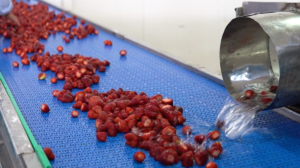
Textured surfaces are typical in beverage bottling, fruit sorting, or frozen‑food production, where controlled movement is crucial.
Grooved or Ribbed Surface
Grooves and ribs are molded or machined into the belt to direct liquid flow or increase grip.
Longitudinal grooves can channel water away, while cross‑direction ribs help air circulation or hold light products in place.
Ribbed belts appear in washing lines, cooling conveyors, and bakery production, where airflow and drainage are necessary for temperature control.
Perforated or Mesh Surface
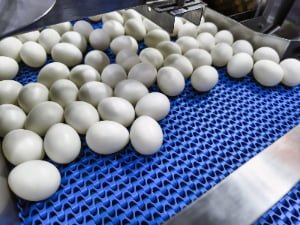
Perforated belts contain holes or openings that allow air or liquid to pass through.
This design enhances ventilation and drainage, improving product cooling or drying.
Perforated or wire‑mesh belts are commonly used in cleaning systems, frying lines, or chillers, where efficient heat exchange is a priority.
Each pattern serves a specific mechanical or hygienic purpose, and the correct choice depends on the process requirements.
Technical Factors Influenced by Surface Patterns
The structure of a belt’s surface directly affects its performance. Several parameters determine how effectively it interacts with both the product and the working environment.
- Friction coefficient: high‑friction surfaces hold items firmly; low‑friction smooth belts support accumulation or easy transfer.
- Airflow and drainage: grooves and perforations manage cooling or moisture removal.
- Product contact area: the amount of contact influences heat transfer, drying time, and the effect of condensation.
- Cleaning: smooth belts are easier to clean, while textured or perforated belts may require more frequent maintenance.
Maintaining a balance between product grip and cleanability is essential. The right surface pattern minimizes residue while keeping product movement consistent.
Technical Factors Influenced by Surface Patterns
The structure of a belt’s surface directly affects its performance. Several parameters determine how effectively it interacts with both the product and the working environment.
- Friction coefficient: high‑friction surfaces hold items firmly; low‑friction smooth belts support accumulation or easy transfer.
- Airflow and drainage: grooves and perforations manage cooling or moisture removal.
- Product contact area: the amount of contact influences heat transfer, drying time, and the effect of condensation.
- Cleaning: smooth belts are easier to clean, while textured or perforated belts may require more frequent maintenance.
Maintaining a balance between product grip and cleanability is essential. The right surface pattern minimizes residue while keeping product movement consistent.
Application Examples by Industry
Each industry adopts a surface design suited to its production process.
The following examples illustrate typical combinations of belt surface and function:
| Industry | Common Surface Pattern | Main Purpose |
|---|---|---|
| Food & Bakery | Perforated or mesh | Promote cooling and airflow after baking |
| Beverage & Bottling | Textured or ribbed | Prevent product slippage on wet surfaces |
| Fruit & Vegetable Processing | Grooved | Support drainage and cleaning during washing |
| Packaging & Logistics | Smooth | Enable accumulation and steady product transfer |
| Pharmaceutical | Smooth or fine‑textured | Facilitate clean, precise product handling |
Each environment has distinct needs — such as temperature control or hygiene — guiding its choice of surface design.
Maintenance Considerations for Different Surface Patterns
The service life and cleanliness of a conveyor belt rely on appropriate maintenance practices.
Because each surface pattern interacts differently with materials and liquids, inspection intervals and cleaning methods must be adapted.
- Smooth belts can be wiped or rinsed quickly, making them efficient for frequent sanitation.
- Textured belts should be checked for buildup inside small recesses where residue can accumulate.
- Grooved belts benefit from high‑pressure washing to remove trapped particles.
- Perforated belts require regular inspection to ensure that holes remain unobstructed for airflow or drainage.
Routine maintenance increases reliability and prevents unexpected downtime.
A brief visual check of surface condition and belt tension aids early detection of wear or contamination.
Selection Guidelines
Before choosing a conveyor belt surface, engineers can review several technical aspects:
- Product Type: solid, liquid, packaged, or unpackaged items influence pattern choice.
- Process Angle and Speed: inclined conveyors benefit from higher friction or ribbed designs.
- Working Environment: temperature, humidity, and exposure to water or cleaning agents determine material durability.
- Hygiene Requirements: smooth or fine‑textured belts simplify compliance with food‑safety standards.
- Cleaning Accessibility: consider how easily the belt can be cleaned between production cycles.
A practical approach is to balance product control and ease of cleaning.
In some systems, smooth and textured segments are combined to meet both demands.
Surface patterns are not merely aesthetic features.
They define how a conveyor belt interacts with the product, liquid, and air, influencing efficiency and hygiene.
Understanding the mechanical principles behind smooth, textured, grooved, and perforated designs allows engineers and operators to select belts that match their process conditions.
Applying this knowledge helps maintain stable product flow, reduce cleaning time, and extend component life.
With technical experience in conveyor accessories and belt materials, our team provides insight and support to help clients choose belt designs suited to their production environments.