

If you've ever had to replace a conveyor belt and didn't know what material to ask for, you're not alone. The wrong choice leads to early wear, belt failure, or wasted budget.
Conveyor belts are commonly made from PVC, PU, rubber, PP, PE, POM, and metal mesh. The material depends on the belt type and how it is used. Flat or continuous belts typically use PVC, PU, or rubber. Plastic modular belts typically use PP, PE, or POM.
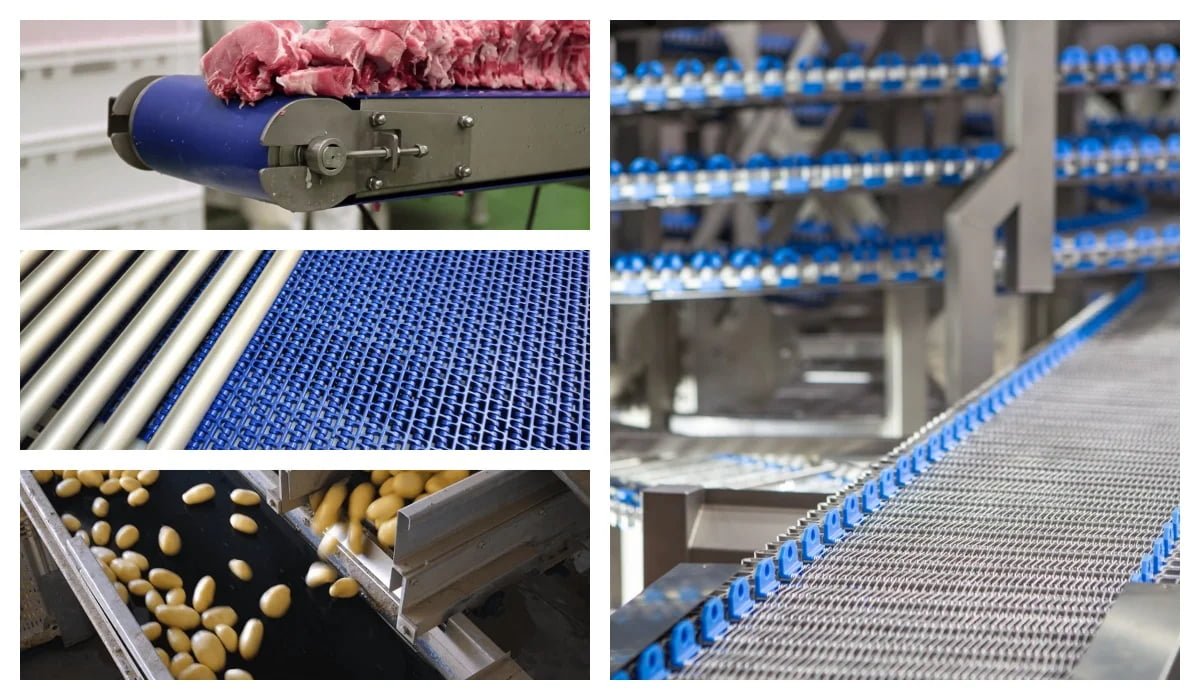
Conveyor belts are not made from one standard material. The material choice depends on the belt construction, the operating environment, and the load the belt needs to carry. To understand this clearly, it helps to look at flat continuous belts and plastic modular belts as two separate groups. Each group uses different base materials, and each material has its own typical strengths and limitations.
What Materials Are Flat and Continuous Conveyor Belts Made From?
Many buyers assume all belts are built the same. They are not. And picking the wrong material for a flat belt is one of the most common sourcing mistakes I see.
Flat and continuous conveyor belts are most commonly made from PVC, PU, or rubber. Each material has different properties in terms of flexibility, oil resistance, temperature tolerance, and surface grip. The right choice depends on the specific operating conditions of the system.

PVC (Polyvinyl Chloride)
PVC is one of the most widely used materials in flat conveyor belts1. It is cost-effective, relatively easy to fabricate, and available in a wide range of surface textures and thicknesses.
PVC belts are commonly used in light to medium-duty conveying applications. They are generally good for dry environments and moderate loads. PVC is not the best choice in applications involving oils, fats, or direct exposure to harsh chemicals, as these can cause the material to degrade over time.
Temperature tolerance for PVC belts is typically limited compared to rubber or PU. In high-heat environments, PVC may not perform well. Most standard PVC belts are suitable for normal indoor operating temperatures, but exact limits depend on the supplier's specifications.
| Property | PVC Belt |
|---|---|
| Flexibility | Good |
| Oil Resistance | Low to moderate |
| Temperature Tolerance | Limited (typically low to moderate range) |
| Cost | Lower compared to PU or rubber |
| Surface Options | Wide variety available |
PU (Polyurethane)
PU belts are often seen as a step up from PVC in terms of material performance. PU offers better resistance to oils, fats, and mild chemicals compared to PVC. It is also more flexible in lower temperatures and generally more resistant to abrasion.
PU is a common choice in environments where cleanliness and surface hygiene are important. The surface of a PU belt is smoother and easier to clean than many rubber belts. PU also tends to be more resistant to hydrolysis than some other synthetic materials, though this depends on the specific formulation and operating conditions.
PU belts are generally more expensive than PVC belts. The exact price difference depends on thickness, surface finish, and supplier.
| Property | PU Belt |
|---|---|
| Flexibility | Very good, including at low temperatures |
| Oil Resistance | Good |
| Temperature Tolerance | Moderate range, varies by grade |
| Cost | Moderate to higher |
| Surface Options | Smooth, grippy, or textured |
Rubber
Rubber conveyor belts are a traditional and widely used option, especially in heavy-duty or outdoor industrial applications. Natural rubber and synthetic rubber variants such as SBR, EPDM, and neoprene are all used depending on the specific need.
Rubber is known for its high tensile strength, good impact resistance, and ability to handle rough or heavy loads. It is commonly used in mining, aggregate handling, and other demanding environments. Rubber belts can also be made with specific compounds for heat resistance or chemical resistance, though the exact performance depends on the rubber formulation.
Rubber belts are generally heavier and less flexible than PVC or PU belts. Cleaning can also require more attention depending on the surface texture.
| Property | Rubber Belt |
|---|---|
| Flexibility | Moderate to good depending on compound |
| Oil Resistance | Varies by rubber type |
| Temperature Tolerance | Can be high with the right compound |
| Durability | High for heavy-duty use |
| Weight | Heavier than PVC or PU |
What Materials Are Plastic Modular Belts Made From?
Flat belts are not the only option in conveyor systems. Plastic modular belts are built differently, and so are the materials used to make them.
Plastic modular belts are most commonly made from PP (polypropylene), PE (polyethylene), or POM (polyoxymethylene, also known as acetal). Each material offers different performance in terms of strength, chemical resistance, temperature tolerance, and load-bearing capacity.

PP (Polypropylene)
PP is the most common base material in plastic modular belts. It is lightweight, has good chemical resistance, and is relatively low in cost compared to POM. PP is suitable for general conveying applications and performs well in environments where mild chemicals or cleaning agents are used regularly.
PP has moderate temperature resistance. It is generally not recommended for very high-temperature applications, but it handles typical operating temperatures found in many standard industrial environments. The exact upper temperature limit varies by the specific PP grade and any additives used by the manufacturer.
One characteristic of PP worth noting is that it can creep or deform under high continuous load over time. For light to medium loads, PP modular belts are a practical and widely used choice.
| Property | PP Modular Belt |
|---|---|
| Weight | Light |
| Chemical Resistance | Good for mild chemicals |
| Temperature Tolerance | Moderate |
| Load Capacity | Light to medium |
| Cost | Lower compared to POM |
PE (Polyethylene)
PE is another material used in plastic modular belts, though it is less common than PP or POM in most industrial conveyor systems. PE offers good impact resistance and is softer than POM or PP, which can be useful in applications where the belt needs to handle delicate or soft items.
PE has lower rigidity compared to POM, which means it is more flexible but also less stiff under load. It is often used in applications where surface contact with the conveyed product is a concern and where a softer belt surface is preferred.
HDPE (high-density polyethylene) is the variant most commonly seen in conveyor belt applications2. PE is generally considered easy to clean and has decent resistance to moisture and many chemicals.
| Property | PE Modular Belt |
|---|---|
| Rigidity | Lower than POM |
| Surface Softness | Higher than PP or POM |
| Chemical Resistance | Good |
| Temperature Tolerance | Low to moderate |
| Typical Use | Lighter or more delicate product handling |
POM (Polyoxymethylene / Acetal)
POM is one of the higher-performance materials used in plastic modular belts. It offers high stiffness, good dimensional stability, low friction, and strong resistance to wear. These properties make POM a common choice for applications that require higher load capacity or where belt rigidity and consistent dimension are important.
POM has a lower coefficient of friction compared to PP3, which means products move more smoothly over the belt surface in many setups. It also performs better under higher operating temperatures compared to standard PP grades, though the exact temperature range depends on the specific POM formulation and any additives used.
The trade-off is cost. POM modular belts are generally more expensive than PP belts. For applications where performance demands justify the cost, POM is a reliable and widely used material choice.
| Property | POM Modular Belt |
|---|---|
| Stiffness | High |
| Wear Resistance | Good |
| Surface Friction | Low |
| Temperature Tolerance | Better than PP in many grades |
| Cost | Higher than PP |
Are Any Conveyor Belts Made From Metal?
Most buyers think of plastic or rubber when they hear the word conveyor belt. But metal is also used in specific situations.
Metal conveyor belts, including stainless steel belts and metal mesh belts, are used in applications that require high temperature resistance, open airflow, or exposure to conditions that would damage plastic or rubber materials. They are a separate category with their own design requirements.
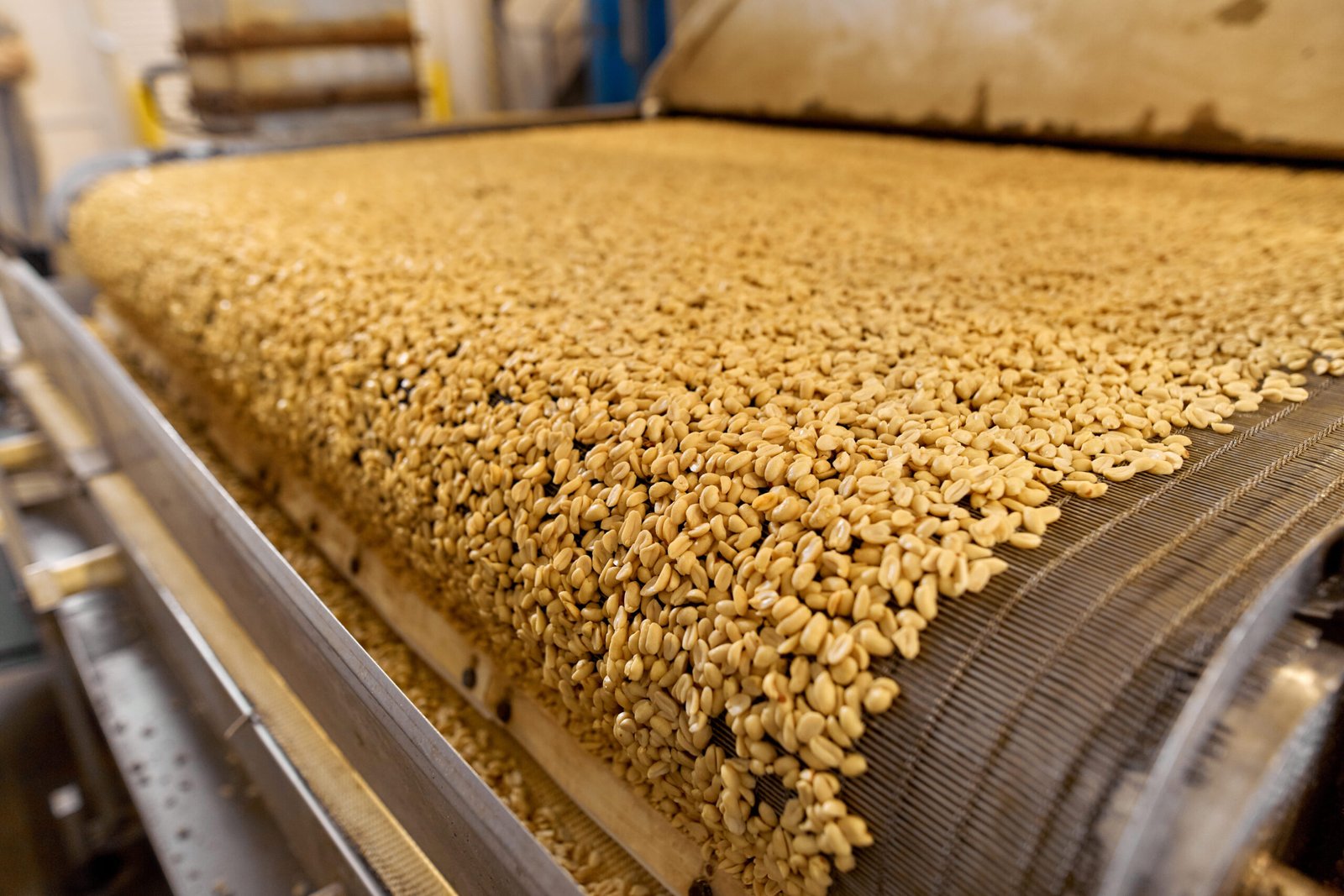
Metal belts are not the standard choice for most general conveying applications. They are typically selected when no plastic or rubber material can handle the operating conditions. High temperatures, direct flame, heavy loads in harsh environments, or specific hygiene requirements in certain processes are situations where metal belts are commonly considered.
Stainless steel is the most common metal used in these belts. It offers good corrosion resistance, high temperature tolerance, and structural strength. Metal mesh belts allow airflow through the belt surface, which is useful in drying, cooling, or heating processes.
The design, installation, and maintenance of metal belt systems are generally more complex than plastic modular or flat rubber/PVC/PU systems. Drive components, tension management, and cleaning methods all differ significantly from standard plastic or rubber belt systems.
| Belt Type | Typical Material | Key Use Case |
|---|---|---|
| Stainless steel belt | 304 or 316 stainless steel | High temp or corrosive environments |
| Metal mesh belt | Steel or stainless steel wire | Airflow-required processes |
| Flat metal belt | Stainless steel | Heavy-duty or high-temp conveying |
Metal belts represent a distinct category and are worth a separate discussion on their own. For most standard conveyor applications, the materials covered in the earlier sections are the more common reference point.
Conclusion
Conveyor belts are made from a range of materials. The common ones are PVC, PU, rubber, PP, PE, POM, and metal. The right material depends on the belt type, operating conditions, and load requirements.
"Conveyor Belt Market Share, Analysis, Report | 2035 - MRFR", https://www.marketresearchfuture.com/reports/conveyor-belt-market-42122. Industry analyses of conveyor belt materials consistently identify PVC as a leading substrate for flat belt construction owing to its low cost, processability, and availability in varied surface profiles. Evidence role: general_support; source type: research. Supports: PVC is a dominant material in flat conveyor belt production due to cost and versatility. Scope note: Market share figures vary by region and application sector; a single global statistic may not capture the full distribution of material usage. ↩
"Plastic Modular Belting | MIR Inc.", https://www.mir-belting.com/plastic-modular/. Materials engineering references indicate that high-density polyethylene provides superior stiffness and load-bearing capacity compared to low- or medium-density variants, making it the practical choice where polyethylene is specified for structural conveyor belt components. Evidence role: general_support; source type: research. Supports: HDPE is preferred over lower-density PE grades in conveyor belt modules due to its higher stiffness, tensile strength, and dimensional stability. Scope note: Direct comparative usage statistics for PE grades in conveyor belt manufacturing are not widely published; the preference for HDPE is inferred from its mechanical property advantages. ↩
"Tribological behavior and morphology of PTFE particulate ... - HERO", https://hero.epa.gov/reference/3869157/. Engineering plastics property databases report that polyoxymethylene (acetal) typically exhibits a coefficient of friction against steel in the range of 0.10–0.35, generally lower than polypropylene values of 0.25–0.45, supporting its use in low-friction conveyor applications. Evidence role: statistic; source type: research. Supports: POM exhibits a lower coefficient of friction against common contact surfaces than polypropylene, as documented in engineering plastics property databases. Scope note: Friction coefficients are highly sensitive to surface finish, lubrication, contact pressure, and sliding speed; published ranges should be treated as indicative rather than definitive for specific belt-to-rail contact conditions. ↩