

In a modern bakery, efficiency is not measured only by production speed—it is equally defined by product quality and consistency.
Among all stages in a baking process, cooling is often overlooked but profoundly influences the final product’s texture, shelf life, and appearance.
A properly designed spiral conveyor system brings together space efficiency, hygiene, and stable performance, making it the centerpiece of today’s cooling tower solutions.
The Cooling Stage: The Hidden Factor Behind Product Quality
Cooling is much more than bringing the product to ambient temperature—it’s a precise phase that finalizes the baking process.
Freshly baked goods contain residual heat and moisture. If cooling is too rapid, it causes cracking and collapse; too slow or uneven, it leads to sogginess and microbial growth.
By designing an optimized airflow, consistent temperature gradient, and stable transfer timing, bakeries can maintain uniform product texture and prevent deformation.
Proper cooling ensures that each loaf, bun, and pastry reaches the ideal firmness before packaging—preserving flavor, appearance, and product shelf life.
A well-planned cooling stage bridges the transition from baking excellence to packaging stability.
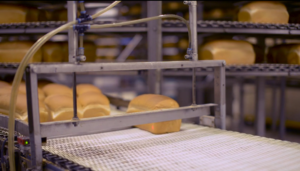
Spiral Conveyors: Vertical Design for Maximum Space and Efficiency
Space constraints are a common challenge in the bakery industry. Spiral conveyors solve this problem elegantly through a vertical architecture that transforms a limited ground area into an extended cooling pathway.
Unlike linear cooling conveyors, the spiral system circulates products in continuous upward or downward motion, significantly increasing dwell time while maintaining a controlled speed and uniform airflow.
This design ensures even cooling across layers, enabling precise temperature control and smooth production rhythm.
For high-throughput bakery lines—bread, cakes, or pies—the spiral structure supports continuous flow without interruption, reducing accumulation and handling errors.
In essence, it combines compact design, efficient production, and consistent product quality—essential elements for modern bakery operations.
Material Selection: Balancing Hygiene and Structural Strength
Every conveyor system is only as reliable as the materials that build it.
In bakery cooling towers, we typically adopt a plastic + stainless steel combination to meet both hygiene and mechanical demands.
- Plastic Components (Food Contact Surface):
Food-grade materials such as UHMW-PE or POM provide smooth surfaces with low friction. They resist sticking and contamination, are easy to wash, and ensure compliance with FDA or EU food safety standards. Their quiet operation contributes to a more comfortable production environment and eliminates the need for lubricants that could contaminate food. - Stainless Steel Structure (Support and Strength):
Stainless steel frames and side reinforcements deliver the mechanical robustness necessary to bear the load of large continuous runs. They maintain shape under high stress, resist corrosion in humid bakery conditions, and enhance the overall durability of the system.
The synergy between plastic and stainless steel offers the best of both worlds—cleanliness, strength, and longevity. It is a proven material strategy for building cooling conveyors that run smoothly day after day with minimal maintenance effort.
Structural Optimization: Achieving Uniform and Efficient Cooling
Designing a spiral conveyor is not only about geometry—it’s about airflow, energy balance, and thermal control.
Uniform cooling depends on coordinated interaction between air direction, fan speed, and heat exchange across each layer of the spiral.
Optimizing pitch, height, and airflow patterns prevents temperature variation, making sure every product cools at the same rate regardless of its position in the tower.
Advanced designs integrate sensors and temperature feedback systems to automatically adjust cooling intensity based on product type and load volume.
This minimizes energy consumption while maximizing consistency—ensuring that the cooling tower doesn’t just reduce temperature, but stabilizes the entire production line’s rhythm.
In a bakery production line, the cooling stage defines the boundary between craftsmanship and industrial precision.
The spiral conveyor system—with its compact structure, intelligent airflow management, and food-safe material combination—embodies the modern approach to efficient cooling.
By bringing hygiene, stability, and high throughput together, it transforms how bakeries manage space, energy, and quality.
For manufacturers aiming to elevate both productivity and product excellence, optimizing the cooling stage with a properly engineered spiral conveyor is not simply a technical upgrade—it’s a strategic investment in long-term reliability and consumer trust.